

Blog
OT Insights
Hi there! We’re so glad you’ve found your way to The Therapy Network’s blog. This is your go-to space for honest, practical, and heart-led insights into the world of paediatric occupational therapy. Whether you’re navigating meltdowns, messy mealtimes, tricky handwriting, or anything in between – you’re not alone, and you’re in the right place.
At The Therapy Network, our paediatric OTs are here to share tips, ideas, and stories that support your child’s development in ways that are fun, achievable, and rooted in connection. Let’s explore how we can help little ones grow, play, and shine – one small step at a time.

Less Clutter, More Play: How Toy Rotation Can Support Children with ADHD
A playroom full of toys might seem like the perfect environment for play, but for some children with ADHD, too many choices can make it harder to know where to start, stay engaged or pack away afterwards. Toy rotation is a simple strategy that reduces visual clutter and creates a more manageable play environment. In this blog, our Occupational Therapists at The Therapy Network explore how toy rotation can support attention, creativity, executive functioning and independent play — without taking the fun out of playtime.

Beyond the Screen: Helping Children Find Balance Through Play, Movement and Connection
Screens are now part of everyday childhood — from educational apps and online learning to favourite shows, gaming and video calls with family. But children also need opportunities to climb, create, move, imagine, explore and connect with the people and world around them. From an Occupational Therapy perspective, the goal isn’t to label screens as “good” or “bad”. It’s about creating a healthy balance so technology complements, rather than replaces, the real-world experiences children need for development. In this TTN OT Insight, our Occupational Therapists explore why play and movement matter, signs that screen use may be crowding out other important activities, and practical ways families can build healthier technology habits into everyday life.

Beyond the Therapy Room: Why OTs Love Working Where Children Learn
A child can show us so much in a therapy room—but sometimes the missing piece of the puzzle is seeing them in the place where they spend much of their week: school. From managing classroom routines and playground friendships to coping with noise, organising belongings, starting tasks and regulating big emotions, school places many demands on a child at once. From an Occupational Therapist’s perspective, seeing these everyday moments firsthand can provide incredibly valuable insight into what is helping a child participate—and what might be getting in the way. In this TTN OT Insight, we explore why our Occupational Therapists work in schools, what we are looking for during a school visit, and how collaboration between therapists, educators and families can help children feel more confident, capable and included throughout their school day.

From First Finger Foods to Forks: The Bilateral Coordination Skills Behind Independent Eating
One of the most exciting milestones parents celebrate is watching their child feed themselves for the first time. Whether it's grasping a strawberry with tiny fingers or proudly using a spoon (even if half the yoghurt ends up on the table!), every meal is an opportunity for learning. At The Therapy Network (TTN), our Occupational Therapists know that successful feeding isn't just about appetite or trying new foods—it [...]

Crossing the Midline: The Hidden Skill That Helps Children Read, Write and Thrive
Have you ever noticed your child swapping hands while colouring, turning the whole page instead of moving their arm, or using one hand for almost every task? While these behaviours may seem insignificant, they can sometimes point to an important developmental skill that is still emerging—crossing the midline. Crossing the midline is one of the building blocks for handwriting, reading, sports, self-care, and coordinated movement. It allows both sides of the body—and the brain—to work together efficiently. When this skill develops well, children move more smoothly, learn more easily, and tackle everyday tasks with greater confidence. At The Therapy Network (TTN), Occupational Therapists regularly assess and support midline crossing as part of a child's overall motor development, helping children strengthen the foundations they need for learning, independence and participation.
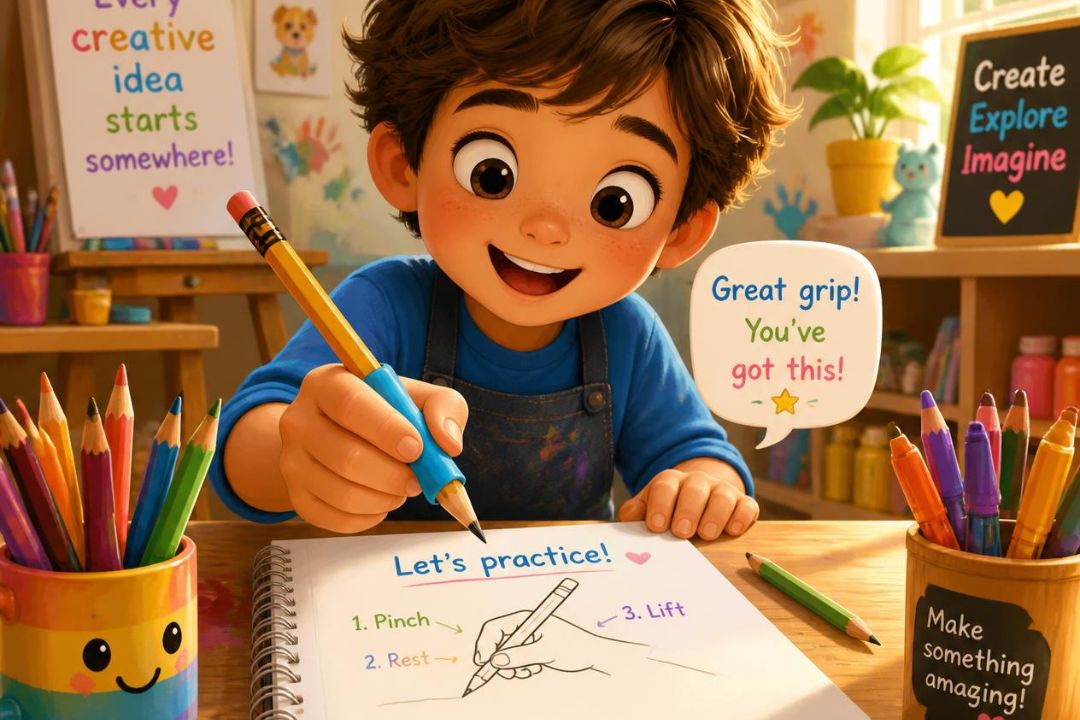
From Fists to Functional: Understanding Pencil Grasp Development in Children
Many parents worry when they notice their child holding a pencil differently from their peers. But did you know that pencil grasp develops gradually through a series of predictable stages? In this blog, our paediatric occupational therapists explain how pencil grasp evolves, what is considered typical at different ages, common misconceptions, and when it may be helpful to seek support. Learn how strength, coordination, posture, and play all contribute to successful handwriting.