
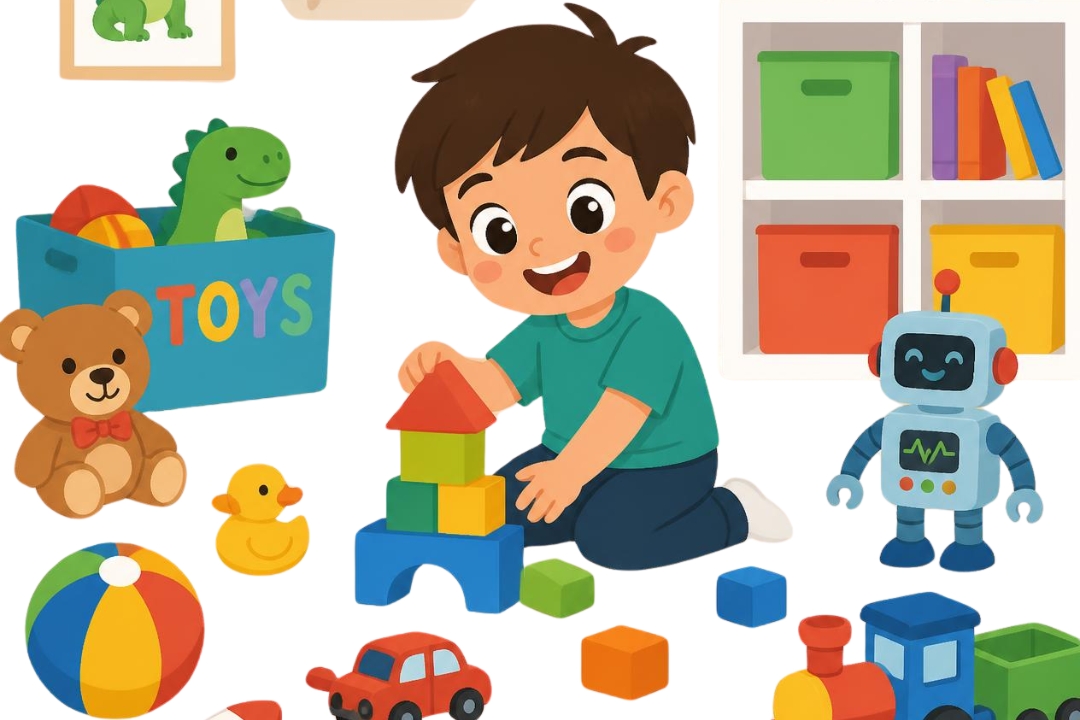
A cupboard full of toys. Baskets overflowing with blocks, cars and puzzles. Shelves packed with games, craft supplies and figurines.
For many families, this is simply what a well-used play space looks like.
But have you ever noticed your child standing in the middle of all those toys saying, “I don’t know what to play with”?
Or perhaps they move quickly from one activity to another, tip out several boxes, play briefly and then move on again.
For some children with ADHD, having more toys available does not necessarily lead to more play.
Sometimes, fewer choices can actually make it easier to get started.
One simple strategy Occupational Therapists may suggest is toy rotation.
What is toy rotation?
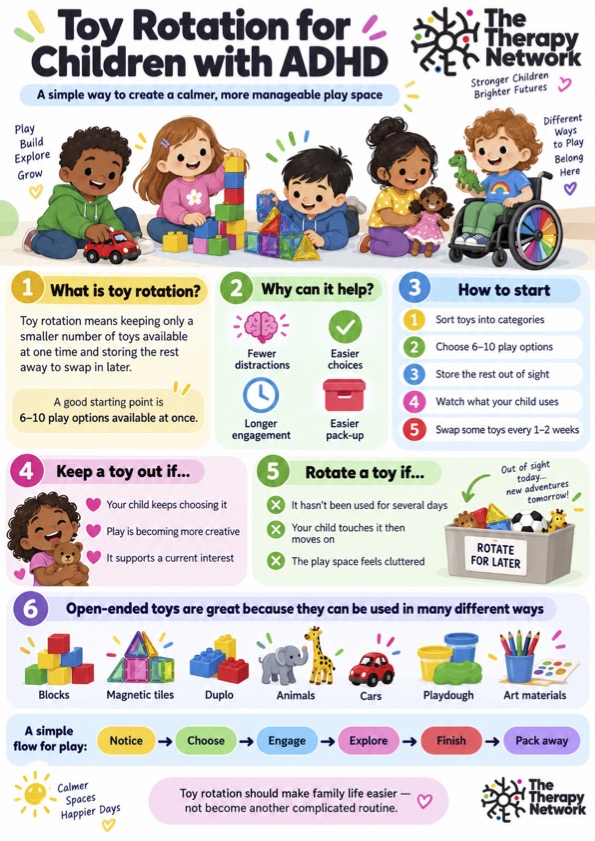
Toy rotation involves making only a smaller selection of toys available at one time while storing the remaining toys away and swapping them periodically.
Rather than having every toy accessible all the time, a family might begin with approximately 6–10 different play options, depending on the child’s age, interests and play needs.
The remaining toys can be stored out of sight and brought back into the play space every week or two, or whenever interest begins to change.
Importantly, toy rotation is not about restricting a child’s play.
Instead, it is about changing the environment to make play easier to navigate.
A calmer, less cluttered space may help a child notice what is available, decide what they would like to do and stay engaged with their play for longer.
Why might toy rotation help a child with ADHD?
Children with ADHD can experience differences in areas including attention, inhibition, working memory, organisation, planning and task initiation.
These executive functioning skills are involved in much more than schoolwork.
They are also used during play.
Imagine walking into a room where twenty different activities are competing for your attention. There are cars on one side, Lego on another, puzzles on the shelf, craft materials on the table and several baskets of toys nearby.
For a child who already finds it difficult to filter distractions, that can be a lot of information to process.
They may:
- move rapidly between toys
- start several activities without developing their play
- tip out multiple containers while searching for something
- become overwhelmed when trying to choose
- struggle to remember what they were doing
- lose interest quickly because something else catches their attention
- find pack-up particularly difficult.
Reducing the number of toys visible at one time can help reduce some of these competing demands.
Instead of continually asking a child to “focus” or “pick one thing,” we can sometimes make focusing easier by adapting the environment around them.
Fewer toys can support longer engagement
When there are fewer competing activities in the room, a child may find it easier to notice a toy, approach it and begin playing.
This can create opportunities for longer periods of engagement.
It does not mean that the child will suddenly sit with one activity for an hour — nor should that necessarily be the goal.
Rather, we are trying to create an environment where staying with an activity feels a little easier.
Toy rotation can encourage deeper and more creative play
Children often discover new possibilities when they have time to become familiar with their toys.
A set of blocks might become:
- a tower one day
- a road the next
- a zoo enclosure later in the week
- a house for figurines
- a bridge for cars
- part of an obstacle course.
When children constantly move from one new toy to another, there may be fewer opportunities to explore these different possibilities.
Open-ended toys are particularly helpful because there is no single “correct” way to use them.
Examples include blocks, magnetic tiles, Duplo, dolls, animals, cars, playdough, cardboard boxes, age-appropriate loose parts and art materials.
Reducing choice can reduce overwhelm
We often think choice is always beneficial for children.
Choice is important — but too much choice can become difficult to manage.
For a child who finds decision-making or task initiation challenging, selecting between thirty activities can require considerable mental effort before play has even begun.
A smaller range of options can make the question:
“What should I play?”
feel much more manageable.
Supporting executive functioning through play
Toy rotation can also provide natural opportunities to practise executive functioning skills.
During play, children are learning to:
- choose between options
- make a plan
- gather materials
- organise what they need
- begin an activity
- remember their idea
- adjust their plan when something does not work
- finish an activity
- pack away before transitioning.
These are many of the same skills children eventually draw upon when managing schoolwork, daily routines and other responsibilities.
Play provides a meaningful place to begin developing them.
Old toys can feel new again
One of the lovely side effects of toy rotation is that toys can regain their novelty.
A toy that has been stored away for several weeks may suddenly feel exciting when it returns.
You may hear:
“I forgot we had this!”
Rather than continually adding new toys to maintain interest, rotating existing toys can sometimes help children rediscover what they already own.
Pack-up can become more manageable
Pack-up requires a surprising amount of executive functioning.
A child needs to stop what they are doing, work out where items belong, organise materials and persist until the task is finished.
When the floor contains pieces from eight different activities, that is a much bigger task.
Fewer available toys generally means fewer materials to organise at the end of play.
Clear baskets, labelled containers, picture labels and consistent storage locations can provide additional support.
How many toys should be available?
There is no perfect number.
For some families, beginning with approximately 6–10 play options works well.
Rather than focusing only on the number of toys, think about providing different types of play experiences.
You might include:
| Type of Play | Examples |
| Construction | Duplo, blocks, magnetic tiles |
| Pretend play | Dolls, kitchen set, doctor kit |
| Fine motor | Puzzles, threading or posting activities |
| Small-world play | Animals, dinosaurs, cars |
| Creative play | Drawing, stickers, playdough |
| Sensory play | Water, kinetic sand, sensory tubs |
| Books | A small mix of favourite and different books |
| Movement | Balls, tunnels, crash pads, stepping stones |
Large pieces of equipment or highly preferred items do not necessarily need to disappear every time you rotate toys.
A play kitchen, climbing equipment, crash pad or favourite construction set might remain available if it continues to support meaningful play.
How often should toys be rotated?
Some families rotate toys every one to two weeks.
Others do it when they notice their child losing interest.
The child’s play is more important than following a calendar.
Consider leaving a toy available when:
- your child continues to choose it regularly
- their play is becoming increasingly imaginative
- they are discovering different ways to use it
- it relates to a strong current interest
- it is helping them practise a particular skill.
It might be time to rotate a toy when:
- it has not been touched for several days
- your child picks it up briefly and quickly moves on
- the play area is becoming visually cluttered
- your child seems unsure where to begin
- other toys are consistently being chosen instead.
There is no need to swap everything at once.
Keeping several favourites while changing two or three other activities can make the transition much easier.
A simple toy rotation system
You do not need an elaborate storage room or colour-coded organisation system.
Keep it simple.
1. Sort toys into broad categories
You might group toys into:
- building and construction
- pretend play
- puzzles and fine motor
- vehicles
- animals and small-world play
- sensory activities
- arts and craft
- music
- books
- movement.
2. Choose a balanced selection
Select one or two options from several categories.
Try to provide variety rather than putting out four different construction toys at the same time.
3. Store the remaining toys out of sight
Tubs, cupboards, storage drawers or baskets can all work.
For some children, toys that are visible but unavailable can still become a distraction.
Storing them completely out of sight can therefore be particularly helpful.
4. Watch what your child actually does
The most useful information comes from observing your child.
Ask yourself:
- What do they choose without prompting?
- What keeps them interested?
- What do they ignore?
- Which toys lead to imaginative or extended play?
- Which activities cause frustration?
- Are they constantly moving between activities?
- Are there toys they use in ways I had not expected?
These observations can guide what remains available and what you introduce next.
Sometimes children need help getting started
Reducing the number of toys does not automatically remove difficulties with task initiation.
Some children with ADHD may still look at six available toys and say:
“I don’t know what to do.”
This is where a simple invitation to play can help.
Rather than placing magnetic tiles in a container, you could:
- build the beginning of a garage
- put two cars beside the tiles
- make the first level of a tower
- add some animals and wonder aloud, “Where could they live?”
You are providing the starting point rather than determining what happens next.
Once the child becomes engaged, they can take the idea in their own direction.
Look for toys that can do more than one thing
Before purchasing another toy, consider asking:
“How many different ways could my child play with this?”
A highly specific toy may initially be exciting but offer only one play experience.
An open-ended toy might support construction, pretend play, problem-solving, fine motor development, social play and creativity depending on how the child uses it.
The value of a toy is not always about how many lights, sounds or features it has.
Sometimes the simplest toys leave the most space for the child’s imagination.
It doesn’t need to be Pinterest-perfect
Toy rotation should make family life easier, not become another task parents feel they have to do perfectly.
You do not need matching containers.
You do not need laminated labels.
You do not need an exact rotation calendar.
And you certainly do not need to secretly reorganise the entire playroom every Sunday night.
Start small.
Put some toys away.
Watch what happens.
Then adjust.
The goal is simply to make it easier for your child to move through the play process:
Notice → Choose → Engage → Explore → Finish → Pack Away
An Occupational Therapy perspective
At The Therapy Network, we often think about whether the environment is helping or hindering a child’s participation.
When a child is finding play, routines, organisation or attention difficult, the answer is not always to expect the child to simply try harder.
Sometimes we can change the task.
Sometimes we can provide additional support.
And sometimes we can change the environment.
Toy rotation is one small example of how an environmental change may support a child’s attention, executive functioning and participation in meaningful play.
Most importantly, it allows us to move away from repeatedly telling a child to “focus” and instead ask a more useful question:
“How can we make it easier for this child to focus here?”
That shift is at the heart of Occupational Therapy.