One of the most common questions we hear from parents as occupational therapists is:
“Is my child holding their pencil correctly?”
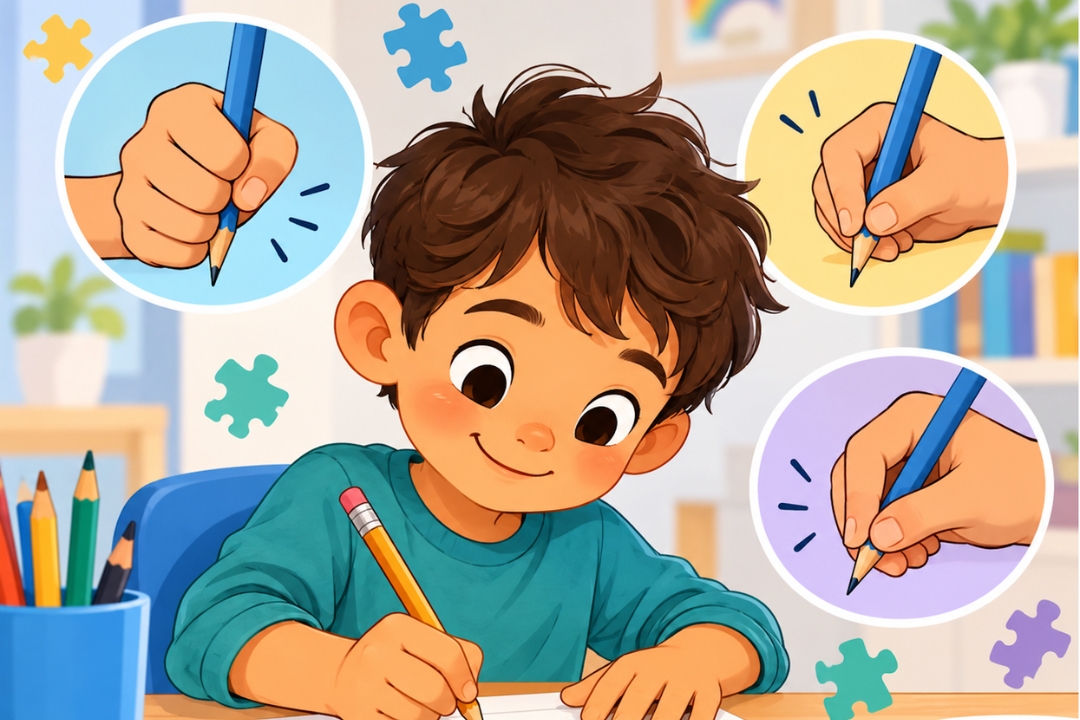
It is an understandable question. Pencil grip is easy to see, so it is often one of the first things parents notice when their child begins drawing and writing.
Perhaps your child holds their pencil in an unusual way. Maybe they grip it incredibly tightly, press so hard that the pencil marks through the page, constantly swap hands or avoid drawing and colouring altogether.
But when we assess a child’s handwriting skills, the pencil grip is only one small part of what I am looking at.
At The Therapy Network (TTN), we know that successful handwriting begins long before a child starts forming letters and writing sentences. It develops through years of climbing, building, squeezing, drawing, playing, moving and exploring.
In other words, little hands need strong foundations before they are ready for big learning.
What Do Occupational Therapists Mean by “Writing Readiness”?
Writing readiness is the combination of skills a child needs to comfortably and successfully learn handwriting.
That includes much more than being able to hold a pencil.
As OT,’s we may look at a child’s:
- hand and finger strength
- fine motor coordination
- shoulder and wrist stability
- core strength and posture
- bilateral coordination
- eye-hand coordination
- visual perception
- motor planning
- attention
- pencil control
- confidence and willingness to participate.
When these underlying skills are working together effectively, children are much better equipped to learn to write without becoming excessively tired, frustrated or overwhelmed.
Does My Child Need the “Perfect” Pencil Grip?
Parents are often surprised when we tell them that we are not necessarily looking for one perfect pencil grasp.
Children naturally experiment with different ways of holding pencils as their hands develop. Many progress through several grasp patterns before developing a more mature grip.
Instead of focusing only on what the grip looks like, we are interested in what that grip allows the child to do.
We might ask:
Can they control the pencil?
Is writing comfortable?
Can they write or draw without becoming exhausted?
Can their fingers move the pencil efficiently?
Is the way they hold the pencil affecting their ability to participate at kinder or school?
An unconventional pencil grip does not automatically need to be “fixed” if the child can write comfortably, efficiently and without pain.
That is why constantly telling a child to “hold your pencil properly” can sometimes do more harm than good. Repeated correction can create frustration and make drawing or writing feel like something they are getting wrong.
Our goal is not simply to create a textbook pencil grasp.
Our goal is to help a child become a comfortable, capable and confident writer.
Strong Hands Make Writing Easier
Think about how much work a child’s hands do during an ordinary school day.
They may need to:
- hold and control a pencil
- colour and draw
- use scissors
- open containers
- manipulate classroom materials
- use glue sticks
- fasten buttons or zippers
- build with construction toys.
When the small muscles of the hands are still developing, these everyday activities can require enormous effort.
You might notice your child gripping their pencil tightly, pressing very hard, changing hands frequently, shaking or rubbing their hands, avoiding writing or becoming frustrated during tabletop tasks.
These behaviours can sometimes be a child’s way of showing us:
“This is hard work for my hands.”
Writing Actually Starts at the Shoulders and Core
One of the things we often explain to families is that handwriting does not begin at the fingertips.
It begins with the body.
Imagine trying to carefully decorate a tiny cupcake while standing on a wobbly chair. It would be much harder to make those small, precise movements because your body would be working so hard just to stay stable.
The same principle applies to writing.
Core strength
A stable core helps a child sit upright, maintain their position at a table and keep their arms free to complete fine motor tasks.
A child who has difficulty maintaining posture may lean across the desk, frequently change position or use one hand to support their body rather than stabilising their page.
Shoulder stability
The shoulder provides the stable base that allows the hand and fingers to make smaller, more precise movements.
If the shoulder is doing too much work, children may move their whole arm when writing instead of developing smaller movements through the wrist and fingers.
Wrist stability
A stable wrist gives the fingers a strong foundation from which to move independently.
This is one reason activities such as climbing, hanging from playground equipment, crawling and pushing can be surprisingly valuable for handwriting development.
Two Hands Are Better Than One
Writing is actually a two-handed activity.
One hand writes.
The other stabilises and moves the paper.
This ability to use both sides of the body together is called bilateral coordination.
If bilateral coordination is difficult, you may notice a child’s page constantly moving around the desk or see them struggling with other two-handed activities such as cutting with scissors, opening containers or dressing.
These skills are connected, which is why occupational therapy often looks beyond handwriting itself when determining what may be making writing difficult.
The Eyes and Hands Need to Work as a Team
Handwriting also requires the brain to coordinate what the eyes see with what the hands are doing.
We call this visual motor integration.
Children use these skills when they:
- copy shapes
- trace
- draw pictures
- form letters
- stay on a line
- space words
- copy information from the board.
Before a child can reliably form letters, they also need experience controlling a pencil through simpler movements such as drawing lines and circles, completing mazes, tracing shapes and creating pictures.
Those scribbles, drawings and “treasure maps” your child makes are not just play.
They are practising skills their brain will later use for handwriting.
Signs Your Child May Need Some Extra Support
Every child develops differently, and occasional difficulty with handwriting is not automatically a cause for concern.
However, it may be worth speaking with an occupational therapist if you regularly notice that your child:
- avoids drawing, colouring or writing
- complains that their hand hurts
- grips their pencil extremely tightly
- presses very hard or barely marks the page
- becomes tired very quickly
- constantly changes their pencil grasp
- uses their whole arm rather than their fingers when writing
- struggles significantly with cutting
- finds buttons, zippers or other fine motor tasks difficult
- becomes distressed or frustrated when asked to write
- continues to struggle despite having plenty of opportunities to practise.
What matters is not one isolated sign but the overall pattern and its impact on participation.
If writing is consistently stopping a child from participating in classroom activities, completing their work or feeling successful, it is worth looking a little deeper.
Put Down the Worksheets: Writing Readiness Develops Through Play
One of our favourite things about working in paediatric occupational therapy is that strengthening the skills needed for handwriting does not have to look like handwriting practice.
In fact, some of the best writing preparation happens without a pencil anywhere in sight.
Playdough
Squashing, rolling, squeezing, pinching and cutting playdough develops hand and finger strength.
Hide tiny objects inside the playdough for your child to find, make pretend food or roll lots of tiny balls using fingertips.
LEGO and construction play
Building with construction toys develops finger strength, precision, bilateral coordination and problem-solving skills.
Picking up and connecting small pieces is fantastic fine motor practice disguised as play.
Threading and beading
Threading beads, pasta or other objects helps develop eye-hand coordination, finger control and attention.
Cutting activities
Instead of simply practising straight lines on worksheets, try cutting out pictures from catalogues, making collages, creating paper snowflakes or cutting ingredients for pretend meals.
Scissor activities support hand strength, bilateral coordination and motor planning.
Make drawing meaningful
Not every child wants to sit down and “practise drawing.”
Instead, connect drawing to something they already enjoy.
Your child could:
- design a treasure map
- draw their favourite character
- make birthday cards
- design a superhero
- create a menu for a pretend café
- draw plans for a LEGO creation
- make signs for their bedroom.
When an activity has a purpose, children are often much more motivated to participate.
Don’t Forget the Playground
If we could prescribe one surprisingly effective handwriting activity for many children, it might simply be:
Go and play.
Climbing, swinging, crawling, hanging, pushing, pulling and exploring playground equipment help build the shoulder stability, core strength, upper body strength and coordination children need for controlled fine motor movements.
That trip to the playground may be supporting your child’s future handwriting far more than you realise.
Everyday Jobs Can Build Strong Hands Too
Children also develop valuable hand skills through ordinary family routines.
Try involving them in jobs such as:
- pegging clothes on the washing line
- stirring cake mixture
- using kitchen tongs
- watering plants
- opening jars and containers
- wiping tables
- carrying age-appropriate groceries
- helping prepare food.
The added bonus is that these activities do more than strengthen hands.
They also promote confidence, independence and participation in family life.
Handwriting Is About Learning — Not Just Neatness
Sometimes handwriting is viewed as simply a matter of making letters look neat.
But the impact goes much further.
When handwriting becomes more automatic, a child can use their mental energy to think about:
- what they want to say
- spelling
- storytelling
- problem-solving
- learning new concepts.
When every letter requires intense physical and mental effort, there is less energy available for everything else the child is trying to learn.
This is why handwriting difficulties can sometimes have a much bigger impact on a child’s school experience than families initially expect.
What Does an Occupational Therapist Actually Assess?
At TTN, we do not assess a child’s pencil grip in isolation.
We look at the whole child and the whole activity.
Depending on the child’s needs, an occupational therapy assessment may explore:
- pencil grasp and pencil control
- hand strength
- fine motor coordination
- shoulder and core stability
- posture
- bilateral coordination
- visual motor integration
- sensory processing
- school readiness
- classroom participation.
Most importantly, we consider why the skill matters to that particular child.
Can they participate in kinder activities?
Can they keep up with classroom writing?
Is their hand becoming sore?
Are they starting to say, “I can’t do it”?
Are they avoiding activities they used to enjoy?
Occupational therapy is not about making children complete endless pages of handwriting practice. We use purposeful, engaging and often play-based activities to strengthen the skills sitting underneath the difficulty.
Progress Doesn’t Happen Overnight
Writing is a complex developmental skill.
Children need repeated opportunities to move, explore, strengthen their bodies, coordinate their hands, practise pencil movements and experience success.
Some children will develop these skills relatively easily.
Others will need more support.
Our role is not to rush development or compare children unnecessarily. It is to recognise when a child is working much harder than they need to and identify what we can do to make participation easier.
As skills develop, confidence often follows.
And confidence matters.
A child who believes “I can do this” is far more likely to keep drawing, writing, experimenting and learning.
How TTN Can Help
At The Therapy Network (TTN), our paediatric occupational therapists support children to develop the strong foundations required for successful handwriting and school participation.
Rather than focusing only on the pencil in a child’s hand, we look at the bigger picture — strength, coordination, posture, visual motor skills, sensory needs, participation and confidence.
Through meaningful play, practical strategies and activities that can be incorporated into everyday routines, we help children develop skills that make writing feel more manageable, efficient and enjoyable.
Because sometimes the answer isn’t simply:
“Practise your handwriting.”
Sometimes it is climbing a little higher, squeezing the playdough a little harder, building one more LEGO creation, helping peg out the washing or drawing the world’s most elaborate treasure map.
Little hands are doing a lot of big learning — and sometimes they just need the right foundations to help those skills grow.