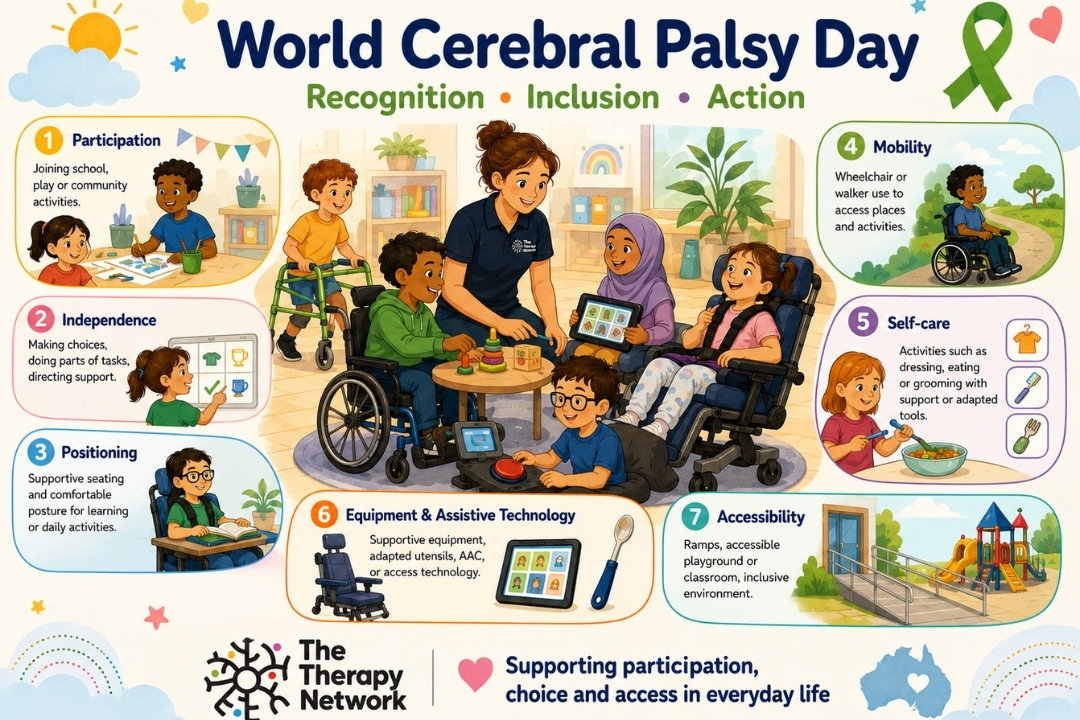
Recognising World Cerebral Palsy Day – 6 October
Each year on 6 October, World Cerebral Palsy Day brings together people with cerebral palsy, their families, supporters and communities around the world.
The global movement focuses on recognition, inclusion and action — celebrating the achievements of people with cerebral palsy while challenging the barriers that can prevent full participation in everyday life.
At The Therapy Network (TTN), these ideas connect closely with the work of Occupational Therapy.
For us, participation is not simply about whether a child can physically complete a task.
It is about asking:
Can they take part?
Do they have choice?
Is the environment accessible?
Do they have the right equipment and supports?
Can they participate in the activities that are important to them?
Every Experience of Cerebral Palsy Is Different
Cerebral palsy is the most common lifelong physical disability, but there is no single experience of cerebral palsy. Movement, mobility, communication and the level or type of support a person requires can vary significantly from one individual to another.
That individuality is important.
As OTs, our starting point should never be an assumption about what a child can or cannot do based solely on their diagnosis.
We want to understand the individual child or young person:
- What matters to them?
- What do they enjoy?
- What would they like to do more independently?
- What is currently difficult or tiring?
- What gets in the way of participation?
- What equipment or environmental changes might help?
- Where is assistance useful and where could greater independence be developed?
From there, we can work towards goals that have meaning in the child’s actual life.
Participation Is the Goal
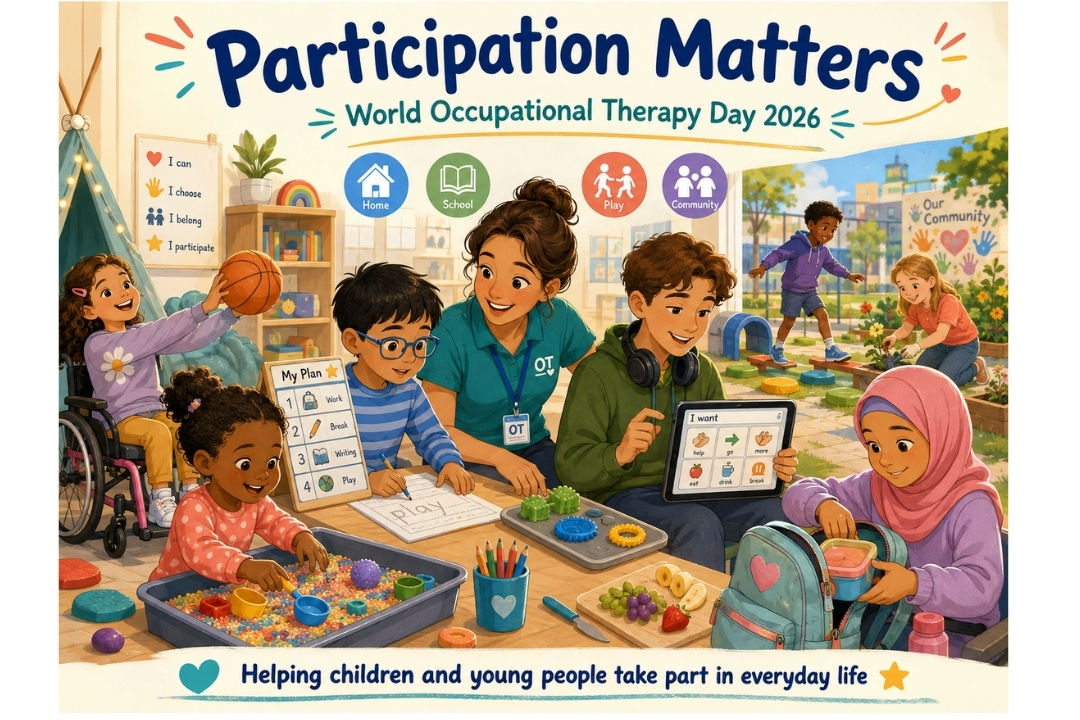
For children and young people, meaningful occupations happen everywhere.
At home, participation might mean getting dressed, eating meals, using the bathroom, helping prepare food or getting ready for school.
At school, it may involve accessing a desk, using learning materials, moving between classrooms, participating in physical education or joining friends in the playground.
In the community, participation might include going shopping, visiting a park, attending a family event, joining a sports program or going out with friends.
The goal of Occupational Therapy is not to make every child perform these activities in exactly the same way.
Sometimes participation happens independently.
Sometimes equipment helps.
Sometimes an environment needs to change.
Sometimes another person provides assistance.
And sometimes technology provides a completely different way to complete the activity.
Different does not mean less successful.
Positioning: Creating a Foundation for Participation
Positioning can influence almost every part of a child’s day.
When a child has appropriate postural support, it may make it easier to use their hands, access learning materials, communicate, eat, play or participate for longer without becoming as fatigued.
An OT may consider factors such as:
- seating and postural support
- positioning during learning
- access to tables and work surfaces
- positioning for self-care
- supported standing
- access to communication technology
- comfort and fatigue
- positioning within wheelchairs or other equipment.
The aim is not simply to create a technically “correct” position.
The position needs to help the child do something that matters.
Mobility Is About More Than Getting From A to B
Mobility is also participation.
Being able to move around the classroom, reach the playground, join family outings or independently move towards the people and activities you choose can have a significant impact on autonomy.
Different children may use different combinations of mobility supports, including wheelchairs, walkers, standing equipment or assistance from another person.
An OT may work alongside physiotherapists, families, equipment suppliers, schools and other professionals to consider how mobility equipment fits into the child’s broader daily life.
The important question is not simply, “Can the child move?”
It is:
“Can they get where they want and need to go, as safely, comfortably and independently as possible?”
Supporting Independence in Self-Care
Dressing, toileting, showering, eating and grooming are everyday activities, but they can place significant demands on motor skills, coordination, balance, endurance and planning.
Occupational Therapy may explore ways to make these activities easier or more accessible.
That could involve:
- practising components of a task
- changing the order of a routine
- adapting clothing
- using specialised utensils
- introducing bathroom equipment
- changing the physical environment
- using visual or other supports
- teaching different ways to complete a task.
Importantly, independence does not always mean completing the entire activity without help.
Independence might mean completing one additional step.
It might mean choosing what to wear.
It might mean directing another person in how to provide assistance.
Or it might mean using equipment to reduce the amount of physical support required.
Having greater control over your own everyday life is an important form of independence.
The Right Equipment Can Change Participation
Assistive technology and equipment can play an important role in reducing barriers.
Depending on the individual child, Occupational Therapists may be involved in assessing, trialling and recommending equipment such as:
- supportive seating
- wheelchairs and mobility equipment
- bathroom and toileting equipment
- positioning equipment
- adapted utensils
- specialised desks or chairs
- transfer equipment
- environmental controls
- technology to support access to everyday activities.
Equipment prescription is much more than choosing an item from a catalogue.
An OT needs to consider the child’s physical needs, goals, home and school environments, growth, family routines, ability to use the equipment and how it will fit into everyday life.
Whenever possible, equipment should be trialled and reviewed to make sure it genuinely improves participation.
The best equipment is not necessarily the most sophisticated option.
It is the equipment that works for the individual person in real life.
Assistive Technology Can Open New Ways to Participate
Technology can also provide alternative ways of doing things that may otherwise require significant physical effort.
For some children and young people, assistive technology may support access to:
- communication
- learning
- computers and tablets
- play
- environmental controls
- schoolwork
- leisure activities
- community participation.
The role of the OT may include considering physical access, positioning, motor control, fatigue and how technology can be integrated into daily routines.
Rather than asking a child to repeatedly practise a task that remains physically difficult, sometimes the most empowering approach is to provide another way to do it.
Sometimes the Environment Is the Barrier
One of the most important shifts in disability practice is recognising that participation difficulties do not always sit within the person.
Sometimes the environment creates the barrier.
A child may have an appropriate wheelchair but be unable to enter a building because there are stairs.
They may be able to participate in class but not if their desk cannot accommodate their seating.
They may be able to join their friends at the playground but not if the play space has no accessible options.
They may be able to complete self-care more independently if the bathroom is arranged differently.
This is why OTs also look at environmental accessibility.
Changes to physical spaces, equipment, routines and expectations can sometimes have just as much impact as working directly on a child’s skills.
Inclusion should not depend on a child being able to adapt themselves to an inaccessible environment.
Independence and Support Can Exist Together
We often associate independence with doing something completely alone.
But people are interdependent throughout life.
We all use tools, technology, environmental supports and help from other people.
For a child with cerebral palsy, meaningful independence may include being able to:
- make a choice
- communicate how they want a task completed
- access equipment independently
- decide when they need assistance
- direct their own support
- participate in decisions
- advocate for what works for their body.
The presence of support does not remove autonomy.
In fact, the right support can create more autonomy.
Inclusion Requires Action
World Cerebral Palsy Day reminds us that awareness alone is not enough.
Recognition matters.
Representation matters.
But accessibility and action matter too.
The World CP Day movement encourages communities to celebrate individuality, challenge stereotypes and work towards a more accessible and inclusive world.
For us as Occupational Therapists, that means continuing to ask:
What is preventing participation?
And perhaps even more importantly:
What can we change?
Sometimes we can build a skill.
Sometimes we can prescribe equipment.
Sometimes we can adapt an activity.
Sometimes we can modify an environment.
Sometimes we can advocate.
And sometimes our role is to listen to the child and family and recognise that they already know exactly what would make participation easier.
From the OTs at TTN
This World Cerebral Palsy Day, the team at The Therapy Network celebrates the individuality, achievements and contributions of people living with cerebral palsy.
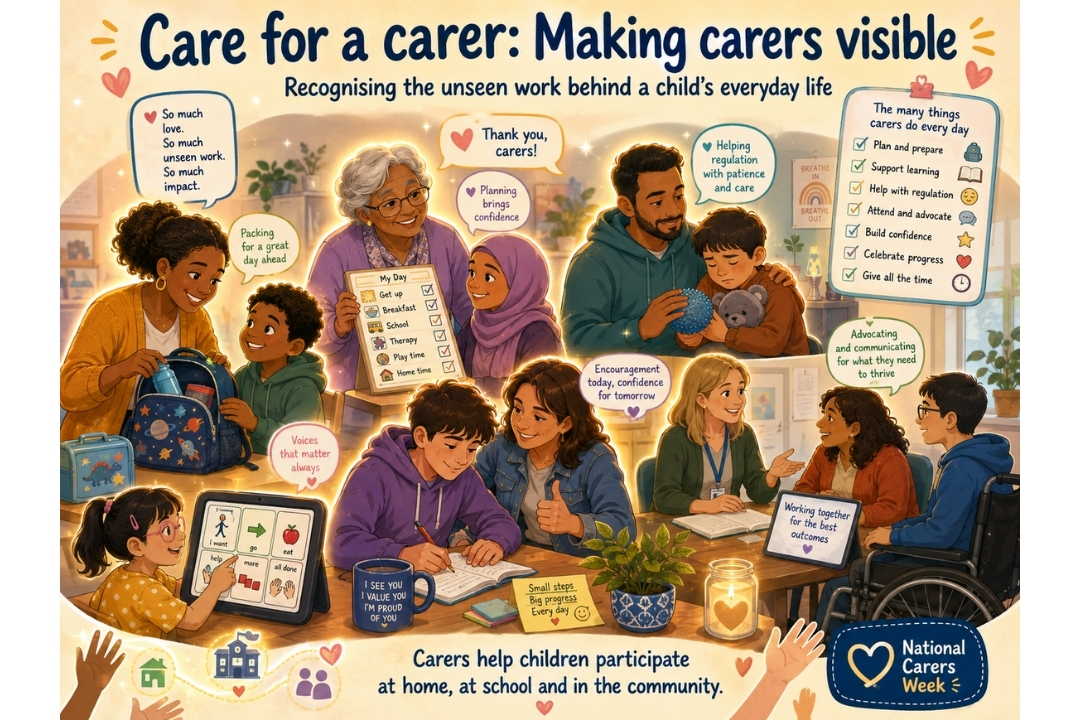
We also recognise the families, carers, schools, therapists and communities who work alongside children and young people to create opportunities for participation.
Our role as OTs is not simply to ask children to become better at navigating barriers.
Where possible, it is also to help remove those barriers.
Because when positioning supports the activity, equipment fits the person, environments become accessible and children have meaningful choice in how they participate, possibilities can change.
Participation should not depend on doing things the same way as everybody else.
It should depend on having the opportunity, support and access to take part in the things that make everyday life meaningful.