
When many people hear the word occupation, they immediately think of a job or career.
But in occupational therapy, the word has a much broader—and much more meaningful—definition.
Occupations are the everyday activities that give our lives purpose, meaning, and identity.
For children, occupations include everything from getting dressed in the morning and eating breakfast to playing with friends, learning at school, riding a bike, drawing pictures, helping set the table, and getting ready for bed.
These everyday activities may seem ordinary, but they are the building blocks of development, confidence, independence, and wellbeing.
At The Therapy Network (TTN), we believe that meaningful participation in daily life is one of the strongest indicators of a child’s overall health and happiness.
What Are Daily Occupations?
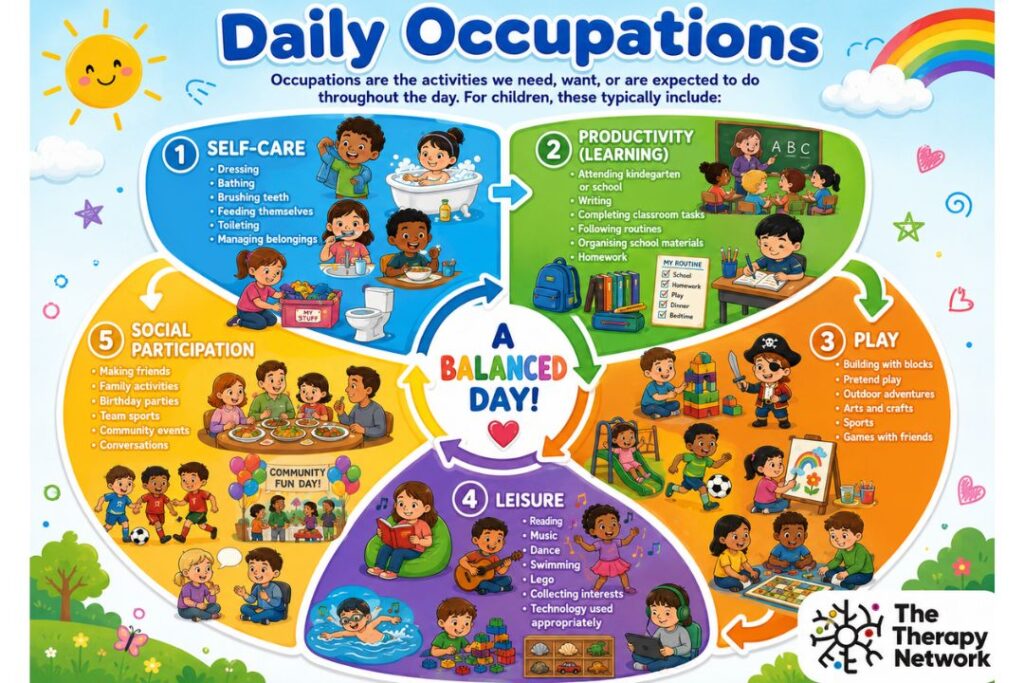
Occupations are the activities we need, want, or are expected to do throughout the day.
For children, these typically include:
Self-Care
- Dressing
- Bathing
- Brushing teeth
- Feeding themselves
- Toileting
- Managing belongings
Productivity (Learning)
- Attending kindergarten or school
- Writing
- Completing classroom tasks
- Following routines
- Organising school materials
- Homework
Play
- Building with blocks
- Pretend play
- Outdoor adventures
- Arts and crafts
- Sports
- Games with friends
Leisure
- Reading
- Music
- Dance
- Swimming
- Lego
- Collecting interests
- Technology used appropriately
Social Participation
- Making friends
- Family activities
- Birthday parties
- Team sports
- Community events
- Conversations
These occupations help children develop the physical, emotional, social, and cognitive skills they need throughout life.
Why Occupations Matter for Wellbeing
When children are able to participate in meaningful occupations, they experience far more than skill development.
They develop:
- Confidence
- A sense of achievement
- Independence
- Resilience
- Belonging
- Emotional regulation
- Self-esteem
- Purpose
Participation allows children to feel capable.
Each success—whether it is fastening a button, joining a playground game, or packing their own school bag—builds the belief:
“I can do this.”
That belief becomes the foundation for lifelong wellbeing.
Wellbeing Is Built Through Participation
Wellbeing is often thought of as simply “feeling happy.”
From an occupational therapy perspective, wellbeing is much broader.
It includes:
Physical Wellbeing
Daily occupations encourage movement, strength, coordination, endurance, and healthy habits.
Examples include:
- Climbing playground equipment
- Riding a bike
- Carrying a school bag
- Cooking with family
- Walking to school
These occupations strengthen both the body and confidence.
Emotional Wellbeing
Meaningful occupations help children manage emotions and develop resilience.
Activities like:
- Drawing
- Building Lego
- Gardening
- Reading
- Listening to music
- Playing outside
can help children regulate their nervous system and recover from stressful experiences.
Many children naturally use occupations as a way to calm themselves.
Social Wellbeing
Children learn social skills by participating alongside others.
Occupations such as:
- Playing games
- Team sports
- Family dinners
- Group learning
- Community activities
teach children how to:
- Share
- Cooperate
- Solve problems
- Communicate
- Build friendships
Participation creates connection.
Cognitive Wellbeing
Everyday occupations develop thinking skills.
Cooking teaches sequencing.
Building teaches planning.
Games encourage flexible thinking.
School routines build executive functioning.
Children often learn best through meaningful activities rather than isolated practice.
It’s Not About Perfection—It’s About Participation
One of the biggest misconceptions parents have is believing children must complete activities perfectly to be successful.
As occupational therapists, we see it differently.
Participation matters more than perfection.
If a child helps pack their lunch—even if it’s messy—they’re learning.
If they attempt to dress themselves—even if the shirt is backwards—they’re building independence.
If they join a playground game for five minutes rather than twenty, they’re still developing social confidence.
Small successes add up over time.
When Daily Occupations Become Difficult
Some children face barriers that make everyday activities much harder.
This may be due to:
- Developmental delays
- Autism
- ADHD
- Sensory processing differences
- Motor coordination challenges
- Anxiety
- Physical disabilities
- Medical conditions
These children may avoid activities because they are difficult, overwhelming, or frustrating.
Over time, reduced participation can affect:
- Confidence
- Friendships
- Independence
- Emotional wellbeing
- Family routines
This is where occupational therapy can make a meaningful difference.
How Occupational Therapists Support Wellbeing
Occupational therapists don’t simply teach isolated skills.
We help children participate in the occupations that matter most to them and their families.
This may involve supporting:
- Morning routines
- School participation
- Handwriting
- Emotional regulation
- Feeding and mealtimes
- Dressing skills
- Play skills
- Friendships
- Community access
- Sleep routines
- Independence at home
Sometimes this involves teaching new skills.
Other times it involves adapting the environment, recommending equipment, or helping adults understand how to better support participation.
Our goal is always the same:
To help children engage meaningfully in everyday life.
Every Occupation Has Meaning
A child isn’t simply brushing their teeth.
They’re developing independence.
A child isn’t simply climbing a ladder.
They’re building strength, confidence, and problem-solving skills.
A child isn’t simply helping cook dinner.
They’re learning planning, sequencing, cooperation, communication, and responsibility.
The occupations themselves become opportunities for growth.
What Can Families Do?
Supporting wellbeing doesn’t require expensive toys or structured activities.
Some of the most valuable occupations happen during ordinary family life.
Try to:
- Encourage children to help with daily routines.
- Allow extra time for independence rather than doing tasks for them.
- Prioritise play every day.
- Celebrate effort over perfection.
- Create opportunities for family participation.
- Choose activities your child enjoys and finds meaningful.
- Remember that small successes lead to lasting confidence.
Children flourish when they have opportunities to participate, contribute, and experience success in everyday life.
The TTN Perspective
busy.”
Every meaningful activity offers an opportunity to develop skills, strengthen relationships, build confidence, and support lifelong wellbeing.
Occupational therapy is ultimately about helping children do the things they need to do, want to do, and love to do.
Because when children are able to participate in the occupations that matter most to them, they don’t just develop new skills—they develop a stronger sense of who they are and what they are capable of achieving.
Our Key Takeaways: Why Daily Occupations Matter
✔ Everyday activities are the foundation of children’s physical, emotional, social, and cognitive wellbeing.
✔ Participation builds confidence, independence, resilience, and a sense of belonging.
✔ Meaningful occupations provide opportunities for learning far beyond therapy sessions.
✔ Occupational therapists support children to engage in the activities that matter most to them and their families.
✔ Wellbeing isn’t achieved through perfection—it’s built through meaningful participation in everyday life.