AAC in Everyday Life: What Does This Mean for Occupational Therapy?
Communication is woven through almost everything we do.
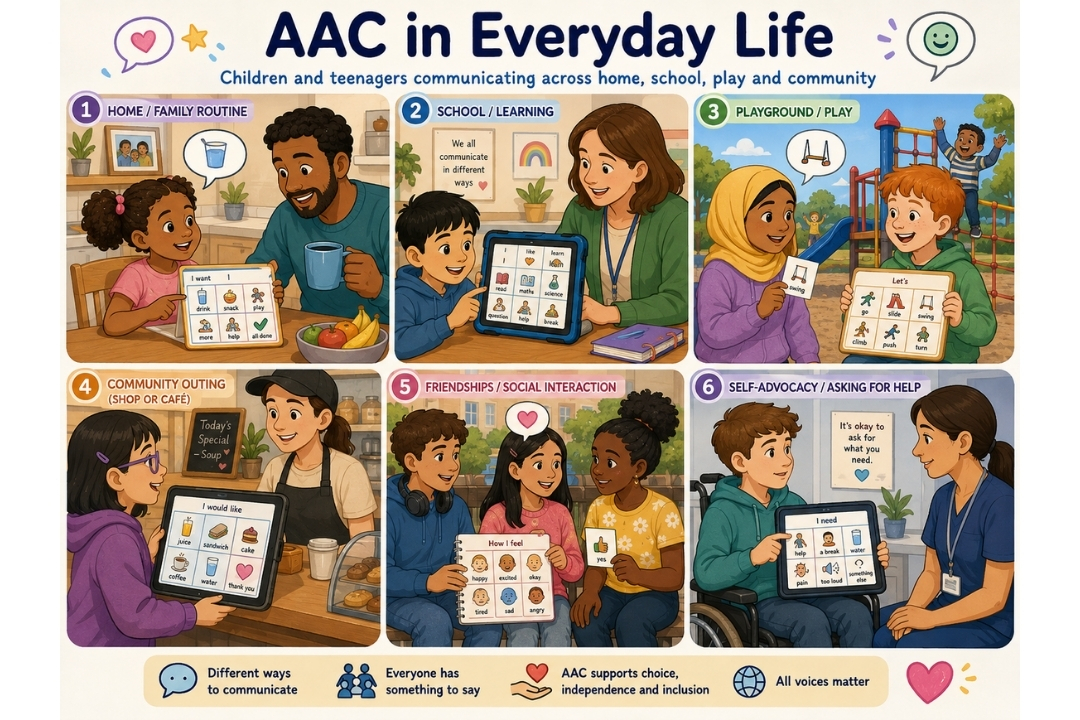
A child communicates when they choose what they want for breakfast, ask for help with their shoes, tell a teacher they need a break, join a game in the playground, disagree with a sibling, choose an activity or tell someone that something does not feel right.
For some children and young people, spoken communication may not be their primary or most reliable way of expressing themselves. Augmentative and Alternative Communication (AAC) can provide additional ways to communicate, from simple pictures, gestures and communication boards through to sophisticated speech-generating devices.
The 2026 AAC Awareness Month theme, “AAC in Everyday Life: Today, Tomorrow, and Beyond,” highlights an important idea: AAC needs to work where life actually happens.
As Occupational Therapists at The Therapy Network (TTN), this connects strongly with the way we think about participation.
Our focus is not simply on whether a child can use a particular skill in a therapy session. We are interested in whether that skill helps them participate more meaningfully at home, at school and in their community.
Communication Is Part of Occupation
Occupational Therapy is centred around the everyday activities, or occupations, that people need and want to do.
For children, this might include:
- getting dressed
- eating meals
- attending school
- playing
- making friends
- participating in family routines
- accessing the community
- completing self-care tasks
- joining recreational activities
- developing greater independence.
Communication is often an essential part of each of these occupations.
A young person may need to communicate that they want a different shirt because the fabric feels uncomfortable. A child may need to tell an adult that the classroom is becoming too noisy. Another child may want to choose who they sit beside, what game they play or how they spend their break.
AAC can help provide a way for those choices, preferences and needs to be heard.
The OT Role in Supporting AAC
AAC is often led by or developed in collaboration with a Speech Pathologist, particularly when assessing a person’s communication needs and selecting an appropriate communication system.
Occupational Therapists can contribute another important perspective: how the person physically, sensory-wise and practically accesses and uses that system throughout their day.
At TTN, this may involve looking at factors such as:
Positioning and Physical Access
A communication device is only useful if a child can comfortably and reliably access it.
An OT may consider:
- seating and postural stability
- upper limb movement
- hand and finger control
- fatigue
- positioning of a tablet or communication device
- mounting options
- alternative access methods
- whether the child can reach and activate their communication system efficiently.
For some children, even a small change in positioning can make communication significantly easier.
Fine Motor and Access Skills
Touching a small symbol on a screen, turning pages in a communication book or accurately selecting an item can require considerable motor control.
OTs may work alongside the child’s communication team to understand whether difficulties accessing AAC are related to motor planning, coordination, strength, dexterity or visual-motor skills.
The solution should not simply be asking the child to “try harder”.
Instead, we can consider how the system or environment might be adapted so communication requires less effort.
Sensory Processing and Regulation
Communication can become much harder when a child’s nervous system is overwhelmed.
A child who can confidently use their AAC system in a quiet therapy room may find it much more difficult in a noisy classroom, busy shopping centre or crowded playground.
An OT may explore how sensory factors such as noise, movement, touch, visual clutter or fatigue influence a child’s ability to access communication.
Sometimes supporting communication begins with helping the child become regulated enough to communicate.
Making AAC Available During Real Routines
One of the strongest messages behind “AAC in Everyday Life” is that communication needs to be available throughout the day — not stored away until someone remembers to bring it out.
From an OT perspective, we can think about where communication naturally occurs within routines.
For example, does the child have access to their communication system while:
- getting dressed?
- eating?
- travelling in the car?
- completing schoolwork?
- playing outside?
- visiting the playground?
- attending appointments?
- shopping?
- participating in sport?
- spending time with friends?
If AAC is difficult to access during the very activities where a child needs to communicate, we may need to reconsider the environment, setup or routine.
Supporting Choice and Self-Advocacy
AAC is about much more than requesting preferred items.
Children and young people need ways to communicate:
yes
no
stop
I need help
I don’t understand
I need a break
that hurts
I don’t like that
I want something different
I have an idea
These messages are important for independence, safety and self-advocacy.
For OTs, this closely aligns with supporting children to recognise their own needs and participate actively in decisions about their bodies, routines and environments.
Building AAC Into Play
Play provides countless opportunities for genuine communication.
Rather than repeatedly asking a child questions to test whether they can use AAC, play can create meaningful reasons to communicate.
A child might use their system to:
- choose a game
- tell someone whose turn it is
- ask for another piece
- protest when someone changes the rules
- comment on something funny
- choose a character
- direct another person
- ask to play again.
When AAC becomes part of enjoyable, meaningful occupations, communication can become something the child uses — rather than something they are being tested on.
Looking Towards “Tomorrow and Beyond”
Children’s communication needs change as they grow.
The communication required by a preschooler is different from that of a teenager preparing for secondary school, employment, further education or greater community independence.
AAC systems and supports therefore need to grow with the child.
Occupational Therapists can help consider future environments and occupations.
For an older child or teenager, this might include being able to:
- communicate with unfamiliar people
- order food
- ask for assistance in the community
- participate in work experience
- communicate with friends
- travel more independently
- make decisions about their own care
- advocate for sensory or environmental adjustments.
Planning for independence means thinking not only about what works today, but what communication and access may need to look like tomorrow and beyond.
The Environment Has a Role Too
Sometimes the biggest barrier is not the child’s ability to communicate.
It is whether other people give them the opportunity.
Children who use AAC may need:
- additional processing time
- communication partners who wait
- adults who model the communication system
- access to their system throughout the day
- people who respond to all forms of communication
- opportunities to initiate rather than only answer questions.
Successful AAC is rarely just about the device.
It is about creating an environment where communication is expected, respected and acted upon.
A Team Approach
AAC works best when the people around the child work together.
Depending on the child’s needs, this may involve collaboration between:
- the child or young person
- parents and carers
- Speech Pathologists
- Occupational Therapists
- teachers
- education support staff
- physiotherapists
- support workers
- other health professionals.
Each team member brings a different perspective.
At TTN, our Occupational Therapists can contribute by looking closely at the relationship between the person, the activity and the environment and considering what may help a child access communication more successfully during everyday life.
Communication Creates Participation
The theme “AAC in Everyday Life: Today, Tomorrow, and Beyond” is a valuable reminder that communication is not something that belongs only in a clinic.
It happens around the breakfast table.
In the classroom.
On the playground.
In the car.
At the shops.
With friends.
At home.
And throughout the many small moments that make up a child’s day.
For us as Occupational Therapists at The Therapy Network, AAC connects closely with one of the central goals of OT: helping children and young people participate more fully in the occupations and relationships that are meaningful to them.
Because when a child has a reliable way to communicate, they have greater opportunities to make choices, express themselves, build relationships, advocate for their needs and have a genuine say in their own lives.
And that matters — today, tomorrow and beyond.