
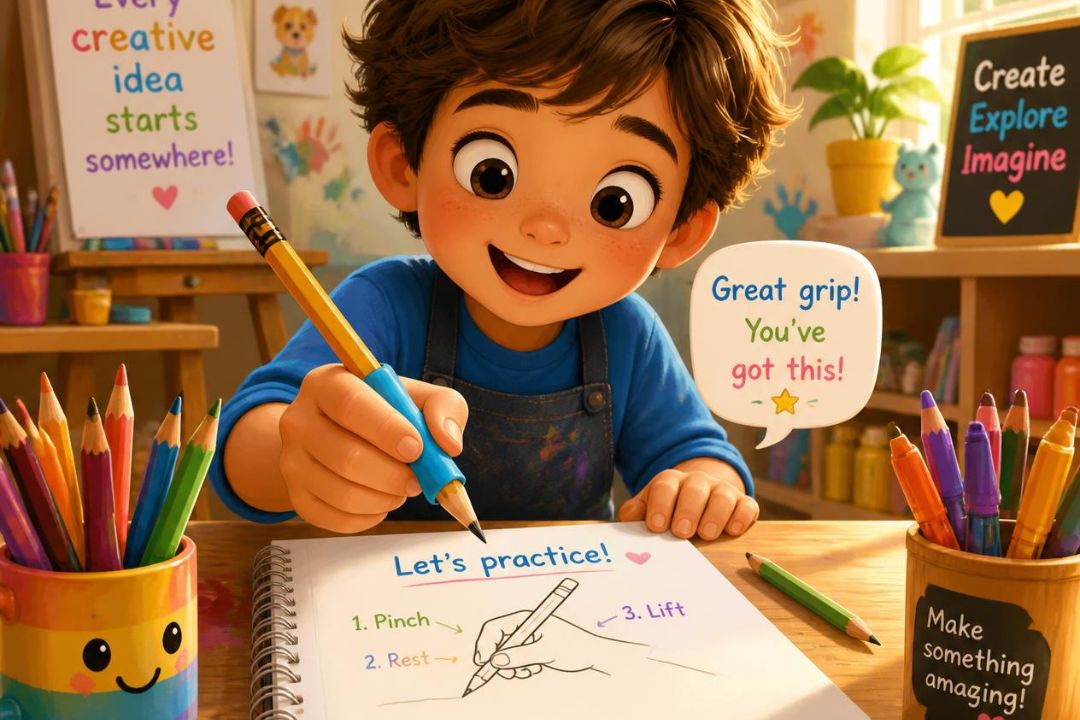
One of the most common questions our occupational therapists hear from parents is:
“Is my child holding their pencil correctly?”
It’s an understandable concern. Handwriting is an important school skill, and many parents worry that an “incorrect” pencil grip will automatically lead to messy writing or learning difficulties.
The good news is that there is no single perfect pencil grip, and children develop pencil grasp gradually over many years. Before expecting a mature grip, children first need to build strong hands, stable shoulders, good posture, and refined fine motor control.
At The Therapy Network (TTN), we look beyond how a child holds their pencil and instead ask:
- Can they write comfortably?
- Do they have enough endurance?
- Is their writing efficient?
- Are they able to keep up with classroom demands?
Understanding how pencil grasp develops can help families know what to expect—and when additional support may be beneficial.
Children are not born knowing how to hold a pencil.
Pencil Grasp Doesn’t Develop Overnight
Like walking, running, or riding a bike, pencil grasp develops through experience and practice.
As babies and toddlers explore toys, blocks, crayons, spoons and everyday objects, they gradually strengthen the muscles needed for handwriting later on.
This development follows a fairly predictable pattern.
Stage 1: Palmar (Fisted) Grasp
Approximate age: 12–18 months
At this stage children hold a crayon or thick marker in their whole fist.
Movement comes from the shoulder rather than the fingers.
This grip is perfect for:
- Scribbling
- Exploring marks
- Building arm strength
- Learning cause and effect
There is absolutely no expectation of controlled drawing at this age.
Stage 2: Digital Pronate Grasp
Approximate age: 2–3 years
The child begins holding the crayon with fingers pointing downward.
Movement still comes mainly from the arm, but children begin making:
- Lines
- Circles
- Larger shapes
This stage allows greater control while continuing to strengthen the hands.
Stage 3: Static Tripod or Quadrupod Grasp
Approximate age: 3½–4½ years
Many preschoolers begin holding the pencil with three or four fingers.
The fingers hold the pencil, but they don’t yet move independently.
Instead, movement comes from the wrist and forearm.
This is completely normal for preschool-aged children.
Stage 4: Dynamic Tripod or Dynamic Quadrupod Grasp
Approximate age: 5–7 years
As children develop greater hand strength and coordination, small finger movements begin controlling the pencil.
This creates:
- smoother writing
- better speed
- improved endurance
- greater precision
Many adults use either a dynamic tripod or dynamic quadrupod grasp successfully.
Both are considered efficient and functional.
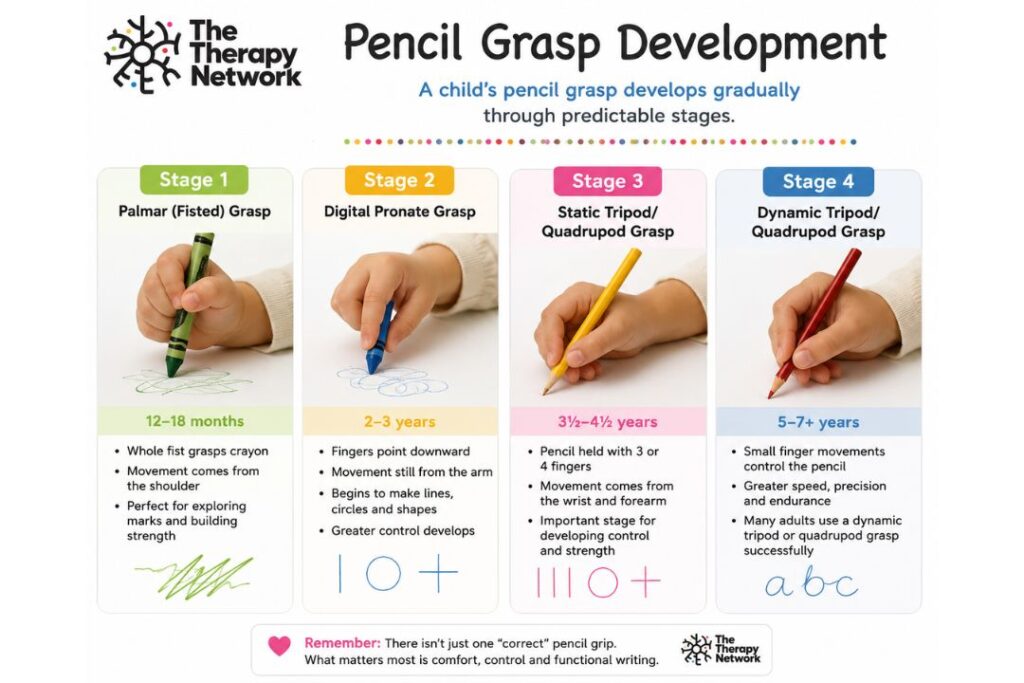
There Isn’t Just One “Correct” Pencil Grip
One of the biggest myths about handwriting is that every child should use a tripod grasp.
Research tells us this simply isn’t true.
Many children—and adults—write beautifully using:
- Dynamic tripod
- Dynamic quadrupod
- Modified tripod
- Modified quadrupod
What matters most is whether the grasp allows efficient writing without pain, fatigue or excessive effort.
What Matters More Than Pencil Grip?
A child’s handwriting success depends on many skills working together.
Hand Strength
Children need strong muscles to control the pencil for extended periods.
Weak hands may lead to:
- tiring quickly
- pressing too hard
- pressing too lightly
- awkward grasp patterns
Shoulder Stability
Stable shoulders provide the foundation for precise finger movements.
Without this stability, children often compensate by gripping the pencil too tightly.
Core Strength and Posture
A stable body allows the hands to move efficiently.
Children who slump or constantly shift position may struggle with handwriting because their bodies are working harder to stay upright.
Bilateral Coordination
Writing requires one hand to write while the other stabilises the paper.
This important skill develops through everyday play.
Finger Dexterity
Children need refined finger movements for:
- forming letters
- adjusting pencil pressure
- writing efficiently
These skills develop through hundreds of everyday play experiences.
Activities That Build Pencil Skills
Parents often ask how they can improve pencil grasp at home.
The answer is surprisingly simple:
Play.
Some of the best activities include:
Playdough
- Rolling
- Pinching
- Squeezing
- Cutting
Construction Toys
- LEGO®
- magnetic tiles
- connecting blocks
Craft Activities
- threading beads
- cutting
- folding
- stickers
Peg Games
- clothes pegs
- tweezers
- tongs
Drawing
- chalk
- crayons
- whiteboards
- easels
Everyday Jobs
- opening containers
- using spray bottles
- cooking
- gardening
These activities strengthen the muscles needed for handwriting naturally.
When Might an Occupational Therapist Help?
Every child develops at their own pace.
However, it may be worth seeking an occupational therapy assessment if your child:
- avoids drawing or colouring
- complains that writing hurts
- tires very quickly
- grips the pencil extremely tightly
- switches hands frequently after age five
- has handwriting that is difficult to read
- struggles to keep up with classroom writing
- becomes distressed during writing tasks
An occupational therapist will assess far more than pencil grip alone.
They will also look at:
- posture
- core strength
- visual motor integration
- fine motor coordination
- sensory processing
- endurance
- classroom participation
The goal isn’t simply to change how the pencil is held—it is to help children become confident, efficient writers who can fully participate at school.
Supporting Development, Not Perfection
It’s important to remember that children don’t need a “perfect” pencil grip to become successful writers.
Development takes time, and every child follows their own pathway.
By providing opportunities for active play, strengthening hands through everyday activities, and supporting children when challenges arise, families can help lay the foundations for confident handwriting.
At The Therapy Network (TTN), we work alongside families, educators and schools to support children’s fine motor development, handwriting skills and participation in everyday learning.
If you’re unsure whether your child’s pencil grasp is developing as expected, our paediatric occupational therapists are here to help assess the bigger picture and provide practical, individualised strategies that build confidence both in the classroom and at home.