
“My child already has a diagnosis. Why do we need to complete another questionnaire?”
It’s one of the most common questions our Occupational Therapists hear when families begin a Functional Capacity Assessment (FCA).
The answer often comes as a surprise.
While a diagnosis is an important part of understanding your child’s needs, it only tells part of the story.
The NDIS doesn’t simply ask, “What diagnosis does this person have?”
Instead, it asks:
“How does this disability affect this person’s ability to participate in everyday life?”
That’s a very different question—and one that requires much more than a medical report.
At The Therapy Network (TTN), we use a range of evidence-based assessment tools to build a detailed picture of how a person’s disability impacts their daily functioning. One of these tools is the World Health Organization Disability Assessment Schedule (WHODAS 2.0).
Although the name sounds technical, its purpose is refreshingly straightforward:
To understand how disability affects real life.
Why Looking Beyond the Diagnosis Matters
Imagine two children who both have an Autism Spectrum Disorder diagnosis.
On paper, they share the same diagnosis.
But in reality, their everyday lives may look completely different.
One child may:
- Independently get dressed each morning
- Attend school with minimal support
- Enjoy birthday parties and community activities
- Communicate confidently with friends
Another child with the same diagnosis may:
- Need assistance with dressing and self-care
- Experience significant sensory overload
- Require support to communicate
- Find community outings overwhelming
- Need help regulating emotions throughout the day
Both children have autism.
Both deserve support.
But their support needs are very different.
This is why functional assessments are so important.
The diagnosis tells us what a person has.
The Functional Capacity Assessment helps explain what that means in everyday life.
What Is WHODAS 2.0?
The World Health Organization Disability Assessment Schedule (WHODAS 2.0) is an internationally recognised assessment developed by the World Health Organization (WHO).
Rather than measuring symptoms or medical conditions, it measures how a person’s health condition affects their ability to function and participate in everyday activities.
It provides Occupational Therapists with structured, evidence-based information about how someone manages daily life across a range of important areas.
Importantly, it focuses on participation—not just impairment.
This approach closely aligns with both modern Occupational Therapy practice and the NDIS philosophy of supporting people to participate as fully as possible in the activities that matter to them.
Why Do Occupational Therapists Use WHODAS During a Functional Capacity Assessment?
A Functional Capacity Assessment aims to answer one central question:
“How does this person’s disability impact their ability to function in everyday life?”
To answer that question accurately, Occupational Therapists gather information from many different sources.
The WHODAS is one important piece of that puzzle.
It complements:
- Clinical observations
- Parent and caregiver interviews
- Discussions with the participant
- School or kindergarten information
- Medical reports
- Standardised assessments
- Occupational Therapy clinical reasoning
Together, these sources help create a comprehensive picture of a participant’s strengths, challenges, participation and support needs.
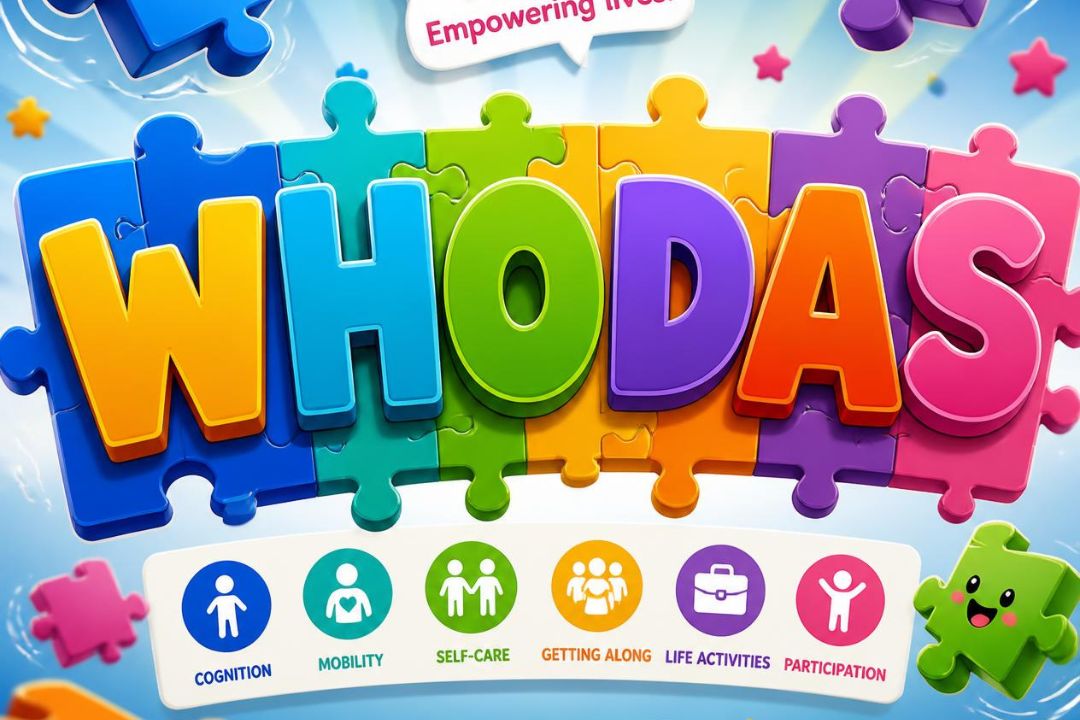
The Six Areas WHODAS Explores
Rather than focusing on one skill, the WHODAS looks across six key areas of everyday functioning.
1. Understanding and Communicating
This section explores how easily someone can:
- Concentrate
- Learn new information
- Remember instructions
- Solve everyday problems
- Understand conversations
- Express themselves effectively
These skills influence participation at home, school, work and in the community.
2. Getting Around
Mobility involves much more than walking.
The assessment considers a person’s ability to:
- Stand
- Move between locations
- Walk varying distances
- Access community environments
- Navigate everyday physical spaces
For some individuals, physical movement may not be the challenge—but navigating busy, unfamiliar or sensory-rich environments may significantly affect participation.
3. Self-Care
One of Occupational Therapy’s core focuses is helping people become as independent as possible.
The WHODAS explores everyday self-care tasks such as:
- Dressing
- Washing
- Showering
- Eating
- Toileting
- Personal hygiene
These everyday activities often become important therapy goals because they contribute greatly to independence and confidence.
4. Getting Along with Others
Participation isn’t just about physical abilities.
Social relationships are equally important.
This section explores:
- Friendships
- Family relationships
- Social understanding
- Managing conflict
- Communicating with others
- Building positive relationships
These skills influence participation in school, community groups, workplaces and family life.
5. Life Activities
This area looks at how disability affects everyday responsibilities.
For children this may include:
- School participation
- Completing classroom activities
- Homework
- Following routines
- Household responsibilities
For adults it may include:
- Employment
- Household management
- Shopping
- Cooking
- Financial responsibilities
Occupational Therapists consider how independently these activities are completed and what supports may be required.
6. Participation in Society
Participation sits at the heart of Occupational Therapy.
This section considers whether disability affects involvement in:
- Community activities
- Sporting clubs
- Recreation
- Social events
- Family outings
- Accessing services
- Meaningful occupations
Sometimes the greatest barriers aren’t physical—they’re environmental, emotional or sensory.
Understanding these barriers helps therapists recommend supports that improve participation and quality of life.
Why Doesn’t the NDIS Just Fund Based on Diagnosis?
This is perhaps one of the biggest misconceptions about the NDIS.
The NDIS recognises that two people with the same diagnosis can have vastly different abilities, goals and support needs.
Funding decisions are based on functional impact.
That means the NDIS wants evidence showing:
- What the person can do independently
- What tasks they find difficult
- What supports they currently need
- How their disability affects everyday participation
- What reasonable and necessary supports may improve independence
The WHODAS helps provide this evidence in a structured and internationally recognised way.
How Is the WHODAS Completed?
Depending on the participant’s age and circumstances, the WHODAS may be completed:
- By the participant themselves
- Together with a parent or caregiver
- Through guided discussion with the Occupational Therapist
- Alongside interviews and observations
There are no right or wrong answers.
Families sometimes worry they’re being “tested.”
They’re not.
The goal is simply to describe everyday life honestly.
One helpful tip we often share is this:
Think about what life usually looks like—not your child’s very best day or their very worst day.
Providing an accurate picture helps ensure recommendations genuinely reflect everyday support needs.
How Does WHODAS Strengthen a Functional Capacity Assessment?
The WHODAS gives Occupational Therapists objective, evidence-based information that strengthens the recommendations made within an FCA.
It helps us:
- Demonstrate functional impact clearly
- Identify areas requiring additional support
- Measure participation restrictions
- Explain barriers to independence
- Develop meaningful therapy goals
- Justify evidence-based NDIS recommendations
- Show how recommended supports are likely to improve everyday functioning
It provides another valuable layer of evidence that supports the overall assessment.
What Does This Mean for Families?
Many families tell us that completing the WHODAS prompts valuable reflection.
It encourages them to think about everyday life in a structured way.
Often families begin noticing:
- Just how much their child has achieved
- Areas where independence has grown
- Tasks that continue to require support
- Goals they hadn’t previously considered
- Everyday challenges that have gradually become “normal”
These insights help shape meaningful therapy goals and support future planning.
The information gathered may also support discussions with:
- Schools
- Kindergartens
- Paediatricians
- Allied health professionals
- NDIS planners
- Support coordinators
WHODAS Is Only One Piece of the Puzzle
No single assessment can fully capture a person’s strengths, challenges and aspirations.
That’s why our Occupational Therapists combine the WHODAS with other evidence, including:
- Parent and caregiver interviews
- Functional observations
- Clinical assessments
- Standardised assessments such as the PEDI-CAT and ABAS (where appropriate)
- School and educational reports
- Medical history
- Goal-setting discussions
- Professional clinical reasoning
Together, these pieces create a comprehensive understanding of a participant’s everyday functioning.
More Than an Assessment—It’s Your Child’s Story
At The Therapy Network, we don’t see the WHODAS as “just another form.”
We see it as an opportunity.
An opportunity to better understand how your child experiences everyday life.
An opportunity to identify strengths that should be celebrated.
An opportunity to recognise where the right supports could increase independence, confidence and participation.
Most importantly, it’s an opportunity to ensure that recommendations are based on your child’s real-life experiences—not assumptions or diagnoses alone.
Because every child deserves to be understood as an individual.
Thinking About a Functional Capacity Assessment?
Whether you’re:
- Preparing for an initial NDIS application
- Getting ready for a plan reassessment
- Seeking updated evidence for funding
- Wanting a clearer understanding of your child’s strengths and support needs
our experienced Occupational Therapists at The Therapy Network are here to help.
We combine evidence-based assessment tools, clinical expertise and a family-centred approach to produce comprehensive Functional Capacity Assessments that accurately reflect everyday functioning and provide meaningful recommendations for the NDIS.
Our goal is simple:
To tell your child’s story clearly, respectfully and accurately—so they can access the supports they need to thrive at home, at school and in their community.