Learning Together at TTN
At The Therapy Network, professional development is about more than completing training.
We want our learning to influence the way we think, the way we work and, most importantly, the experience of the children, young people and families we support.
Our recent Key Word Sign workshop was a wonderful opportunity for our Occupational Therapists to learn together, practise new skills and reflect on the many different ways communication can be supported.
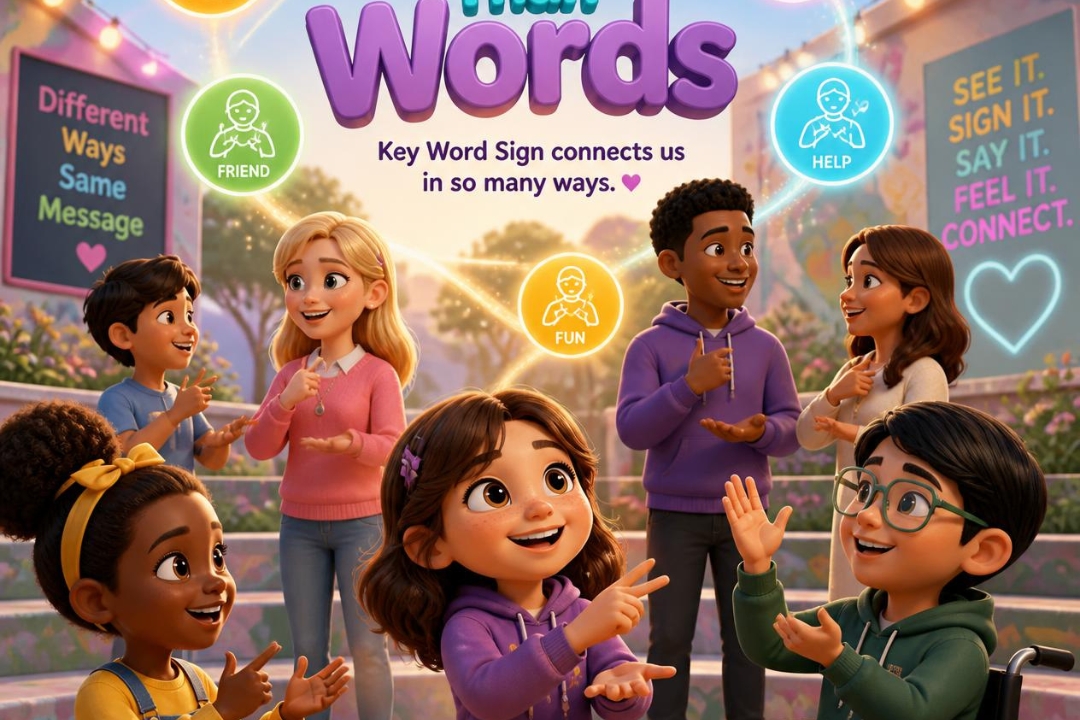
Key Word Sign involves using speech alongside signs and natural gestures, with signs used to emphasise the important or “key” words in a message.
Throughout the workshop, our team had the opportunity to learn signs, practise using speech and sign together and explore how Key Word Sign may be incorporated into everyday interactions.
There was plenty of concentration, encouragement, laughter and willingness to have a go — exactly the kind of learning environment we value at TTN.
Communication Is More Than Speech
One of the strongest messages we took from the workshop was a simple but important one:
Communication does not have to look or sound one particular way.
Children and young people communicate in many ways.
They may use spoken words, facial expressions, gestures, body movements, signs, pictures, communication devices or a combination of different approaches.
When we broaden our understanding of communication, we also broaden the opportunities a person has to connect with others, make choices, ask for help, express preferences and participate in their everyday life.
For Occupational Therapists, this is especially important because participation sits at the heart of our work.
Bringing Communication Into Everyday Occupations
Occupational Therapy focuses on the everyday activities that are meaningful to a person.
For a child or young person, this might include:
- playing
- getting dressed
- eating meals
- attending school
- joining family routines
- interacting with friends
- moving between activities
- participating in the community
- developing greater independence.
These are also the moments in which communication naturally happens.
Rather than thinking about Key Word Sign as something that only occurs during a therapy session, the workshop encouraged us to think about how useful signs might be incorporated into the child’s real-life routines.
Simple concepts such as help, more, finished, stop, wait, go, eat, drink, play or the names of familiar people and activities may support communication during meaningful moments throughout the day.
The goal is not to use as many signs as possible.
It is to identify communication that is useful, meaningful and relevant to the individual person.
One of Our Biggest Takeaways: Everyone Has a Role
Another important reflection for our team was that communication support cannot sit solely with the child.
Children communicate within relationships.
Parents, siblings, grandparents, teachers, education support staff, carers and therapists all play an important role in creating an environment where different forms of communication are recognised and responded to.
This prompted an important shift in thinking.
Instead of only asking:
“What signs could this child learn?”
we also need to ask:
“How can the people around this child make communication easier and more accessible?”That might involve modelling a few useful signs during familiar routines, helping families become comfortable using them, creating simple visual reminders or collaborating with schools and other professionals so communication supports are used more consistently across environments.
Another Tool — Not a One-Size-Fits-All Approach
One of the things we value most about Occupational Therapy is individualisation.
There is no single strategy that will suit every child.
Key Word Sign is therefore not about replacing speech, visual communication, communication devices or other strategies a child may already use.
Instead, it can become another tool within a broader communication toolkit.
For some children it may be highly useful. For others, different communication approaches may be more appropriate.
Our role as OTs is to consider the individual child’s strengths, preferences, communication needs, environments and goals, and to collaborate with families and other professionals when deciding what supports may be helpful.
Learning a Skill Means Using It
Attending a workshop is only the beginning.
Just like the children we work with, adults need repetition and practice when learning something new.
Our TTN team is now looking forward to continuing to practise signs with one another and building confidence in using Key Word Sign naturally.
We also hope to explore opportunities to thoughtfully incorporate what we have learnt into therapy where it is appropriate and relevant to the client’s goals.
This may include modelling signs during play, routines and transitions, helping families identify useful vocabulary or supporting teams to think about how communication strategies can be embedded into everyday environments.
Supporting Participation Through Communication
Perhaps the biggest reflection we took away from the workshop was that communication and participation are deeply connected.
Being able to communicate a preference, ask for help, say “finished”, join an activity or tell someone “no” can have an enormous impact on a person’s sense of independence and involvement in their own life.
As Occupational Therapists, these moments matter to us.
Our Key Word Sign workshop gave our team new practical skills, but it also reinforced something we already believe strongly at TTN:
Every person deserves meaningful ways to communicate, connect with others and have a voice in the activities and relationships that matter to them.
And sometimes, supporting that voice means thinking beyond words.