
Emotional Regulation Versus Behaviour
When a child yells, refuses to participate, runs away, shuts down or becomes physically distressed, it is easy to focus on the behaviour we can see.
We may ask:
“Why are they behaving like this?”
“How do we stop it?”
“Why won’t they just listen?”
However, behaviour is usually the visible outcome of what is happening beneath the surface.
A child may be communicating:
- “This is too hard.”
- “I do not understand what is expected.”
- “The environment is overwhelming.”
- “I am worried.”
- “I need a break.”
- “I do not feel safe.”
- “I cannot find the words to explain what is wrong.”
- “My body needs movement.”
- “I am tired, hungry or uncomfortable.”
- “I need help.”
At The Therapy Network (TTN), as occupational therapists we encourage families, educators and support people to look beyond the behaviour and consider what the child may be trying to communicate.
When we understand the reason behind a behaviour, we are better able to respond with empathy, reduce distress and support meaningful participation.
What Is Emotional Regulation?
Emotional regulation is the ability to recognise, understand and respond to emotions.
For children, this skill develops gradually. It relies on a range of abilities, including:
- noticing body signals
- identifying emotions
- understanding what has caused a feeling
- communicating needs
- managing frustration and disappointment
- coping with uncertainty or change
- using strategies to feel safe and organised
- recovering after becoming overwhelmed
Children are not born knowing how to manage strong emotions independently. They learn through repeated experiences of being supported by calm, responsive adults.
When a child is regulated, they are more able to:
- listen
- communicate
- learn
- play
- solve problems
- manage change
- connect with others
- participate in daily routines
When a child becomes dysregulated, these skills may temporarily become much harder to access.
Behaviour Is What We See
Behaviour is an action that can be observed.
It may include:
- crying
- yelling
- hitting
- pushing
- throwing objects
- running away
- refusing tasks
- hiding
- withdrawing
- becoming very quiet
- avoiding eye contact
- repeatedly asking the same question
- making jokes or distracting others
- moving constantly
- appearing not to listen
Behaviour does not always clearly show the emotion underneath it.
For example, a child who feels anxious may not say, “I am worried about getting the answer wrong.”
Instead, they may tear up their work, refuse to start or distract the class.
A child who is overwhelmed by noise may not say, “The classroom is too loud for my nervous system.”
Instead, they may cover their ears, leave the room or become angry.
A child who does not understand an instruction may not ask for clarification.
Instead, they may avoid the activity or say, “This is boring.”
The behaviour is real, but it is only one part of the picture.
Why Behaviour Is Communication
Children communicate through words, facial expressions, body movements, actions and behaviour.
When children do not yet have the language, confidence, emotional awareness or regulation skills to explain what is happening, their behaviour may communicate it for them.
Behaviour can tell us about:
- unmet needs
- sensory overload
- physical discomfort
- emotional distress
- anxiety
- fatigue
- confusion
- frustration
- communication difficulties
- demands that feel too challenging
- a need for connection
- a need for control or predictability
- difficulties with attention or executive functioning
This does not mean that every behaviour should be ignored or accepted without boundaries.
Children still need clear expectations, safety and support to develop new skills.
However, consequences alone may not change a behaviour if the underlying need remains unaddressed.
When adults respond only to the visible behaviour, they may miss the message the child is trying to send.
The Iceberg Analogy
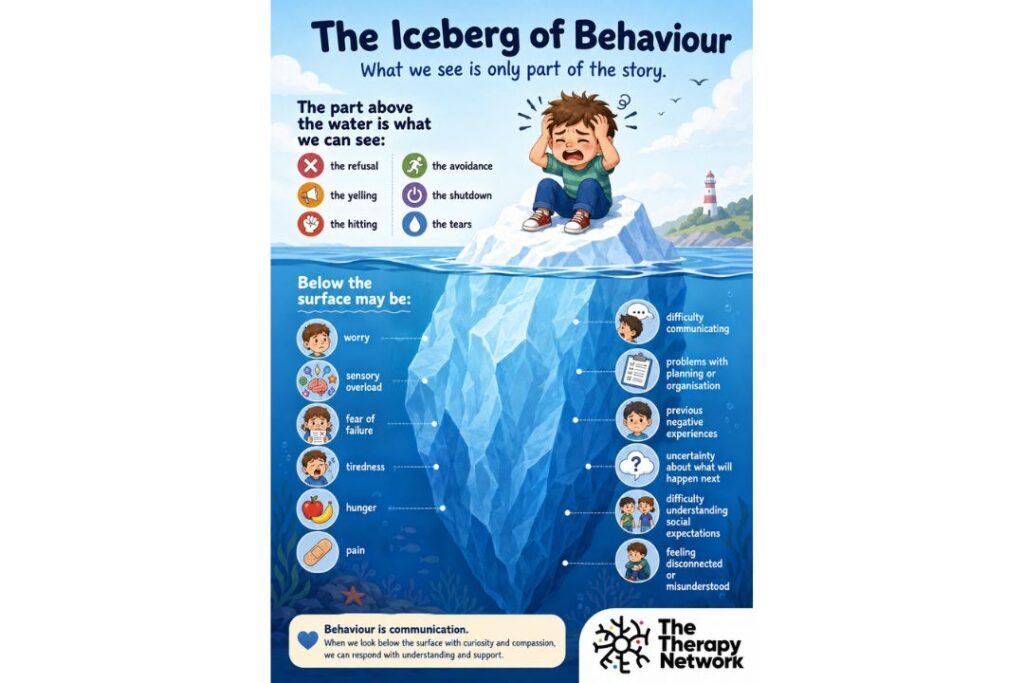
Behaviour is sometimes compared to an iceberg.
The part above the water is what we can see:
- the refusal
- the yelling
- the hitting
- the avoidance
- the shutdown
- the tears
Below the surface may be:
- worry
- sensory overload
- fear of failure
- tiredness
- hunger
- pain
- difficulty communicating
- problems with planning or organisation
- previous negative experiences
- uncertainty about what will happen next
- difficulty understanding social expectations
- feeling disconnected or misunderstood
When we focus only on the top of the iceberg, we may try to correct the behaviour without addressing what is causing it.
Understanding what is below the surface helps us choose more effective and compassionate support.
Dysregulation Is Not the Same as Deliberate Misbehaviour
When a child is emotionally overwhelmed, their nervous system may move into a stress response.
This can look like:
Fight
The child may yell, argue, hit, kick, throw objects or become verbally aggressive.
Flight
The child may run away, leave the room, hide, avoid the activity or repeatedly ask to go home.
Freeze
The child may become silent, appear unable to move, stop responding or seem disconnected.
Fawn
The child may agree with everything, copy others, hide their discomfort or try to please adults despite feeling overwhelmed.
During these responses, the child may not be able to think clearly, process language or use strategies independently.
This is not always a child choosing to be difficult.
It may be a sign that their nervous system is trying to protect them.
Common Messages Behind Behaviour
“This Is Too Hard”
A child may refuse a task, rush through it, distract others or say that they do not care.
The task may require skills that are still developing, such as handwriting, attention, motor planning, language processing or problem-solving.
“I Am Overwhelmed”
Busy classrooms, loud shopping centres, strong smells, unexpected touch or too many instructions can become overwhelming.
A child may cover their ears, leave the space, become irritable or shut down.
“I Need Predictability”
Some children find changes, transitions and uncertainty especially difficult.
They may repeatedly ask what is happening, resist moving to the next activity or become distressed when plans change.
“I Am Worried About Failing”
Avoidance can sometimes protect a child from the possibility of making a mistake.
They may refuse to try, say the task is stupid or become upset before an activity begins.
“I Need Connection”
A child may seek attention through behaviour when they are feeling disconnected, uncertain or in need of reassurance.
“My Body Needs Something”
A child may need movement, rest, food, water, toileting support, reduced noise or a sensory break.
Responding With Curiosity Rather Than Judgement
A helpful shift is moving from:
“What is wrong with this child?”
to:
“What is happening for this child?”
Instead of immediately asking how to stop the behaviour, consider:
- What happened just before it?
- Where did it occur?
- Who was present?
- What demands were being placed on the child?
- Was the environment loud, busy or unpredictable?
- Was the child tired, hungry or unwell?
- Was the task too difficult or unclear?
- Did the child know how to ask for help?
- Has this situation been challenging before?
- What helped the child recover?
Looking for patterns can help adults identify triggers and provide support earlier.
Connection Before Correction
When a child is highly dysregulated, they may not be ready to learn from explanations, consequences or problem-solving.
In that moment, the priority is often helping the child feel safe.
This may involve:
- using a calm voice
- reducing demands
- offering physical space
- limiting unnecessary language
- moving to a quieter environment
- acknowledging the child’s feelings
- providing access to a familiar regulation strategy
- staying nearby without overwhelming the child
- reassuring them that they are not alone
An adult might say:
“I can see that this feels really hard.”
“You are safe. I am here.”
“Let’s take a break.”
“We can talk about it when your body feels ready.”
Once the child is regulated, adults can revisit what happened and help them develop another way to communicate or respond next time.
Co-Regulation Comes Before Self-Regulation
Children learn regulation through co-regulation.
Co-regulation occurs when a trusted adult helps a child manage an emotional or sensory experience.
This may include:
- noticing early signs of distress
- helping the child name what they are feeling
- offering choices
- guiding them to a quieter space
- modelling calm breathing
- breaking a task into smaller steps
- providing reassurance
- supporting them to communicate a need
Over time, these repeated experiences help the child build their own regulation skills.
Expecting a dysregulated child to calm down independently before they have developed these skills may increase their distress.
How we as Occupational Therapists Can Help
As Occupational therapists we consider how emotional, sensory, physical, cognitive and environmental factors affect a child’s participation.
At The Therapy Network we may explore:
- sensory processing
- emotional awareness
- communication
- attention
- executive functioning
- motor skills
- sleep
- daily routines
- transitions
- social expectations
- environmental demands
- the child’s strengths and interests
Support may include:
- identifying patterns and triggers
- teaching children to recognise body signals
- developing emotional vocabulary
- creating visual supports
- introducing regulation tools
- adapting environments
- modifying tasks
- building predictable routines
- supporting transitions
- teaching help-seeking skills
- working with families and educators
- supporting co-regulation strategies
The goal is not to make a child appear compliant.
The goal is to help them feel safe, understood and able to participate in meaningful activities.
Teaching a More Helpful Form of Communication
Once adults understand what a behaviour is communicating, they can help the child develop a safer or more effective way to express the same need.
For example:
Instead of running away, the child may learn to show a break card.
Instead of throwing work, the child may learn to say, “This is too hard.”
Instead of becoming distressed during a transition, the child may use a visual schedule or countdown.
Instead of pushing someone away, the child may learn to say, “I need space.”
Instead of shutting down, the child may point to a feelings scale.
This approach recognises that the need behind the behaviour is valid while supporting the development of new skills.
Behaviour Support Is Not About Blame
Understanding behaviour as communication does not mean blaming parents, educators or the child.
Children’s behaviour is influenced by many interacting factors.
What works one day may not work the next. A child’s ability to cope can change depending on sleep, health, stress, environment and demands.
The most helpful approach is collaborative.
Families, therapists and educators can work together to:
- identify patterns
- share successful strategies
- create consistent responses
- adjust expectations
- support communication
- recognise progress
- protect the child’s dignity
Progress May Look Different Than Expected
Progress is not always the complete absence of challenging behaviour.
It may look like:
- noticing distress earlier
- asking for help
- accepting support
- using a break card
- staying in an activity for longer
- recovering more quickly
- tolerating a small change
- communicating discomfort
- trying again after a mistake
- having fewer intense episodes
- feeling understood by adults
These are meaningful signs that a child is developing regulation, communication and participation skills.
Looking Beyond What We Can See
Behaviour is rarely random.
It often has a purpose, meets a need or communicates something the child cannot yet express in another way.
When adults respond with curiosity rather than judgement, behaviour becomes an opportunity to understand the child more deeply.
At The Therapy Network, as occupational therapists we support children, families and educators to look beneath the behaviour, identify the message and build practical strategies that promote emotional regulation, communication and meaningful participation.
Because when we understand what a child is really communicating, we can move beyond simply managing behaviour and begin providing the support they truly need.