Why Everyday Responsibilities Can Feel Overwhelming
Teenagers are expected to manage increasingly complex responsibilities.
A typical week may involve:
- moving between multiple classrooms and teachers
- remembering homework and assessment dates
- planning long-term assignments
- managing sports, work and social commitments
- organising books, technology and equipment
- preparing for tests
- completing household responsibilities
- responding to messages and emails
- getting enough sleep
- arriving at places on time
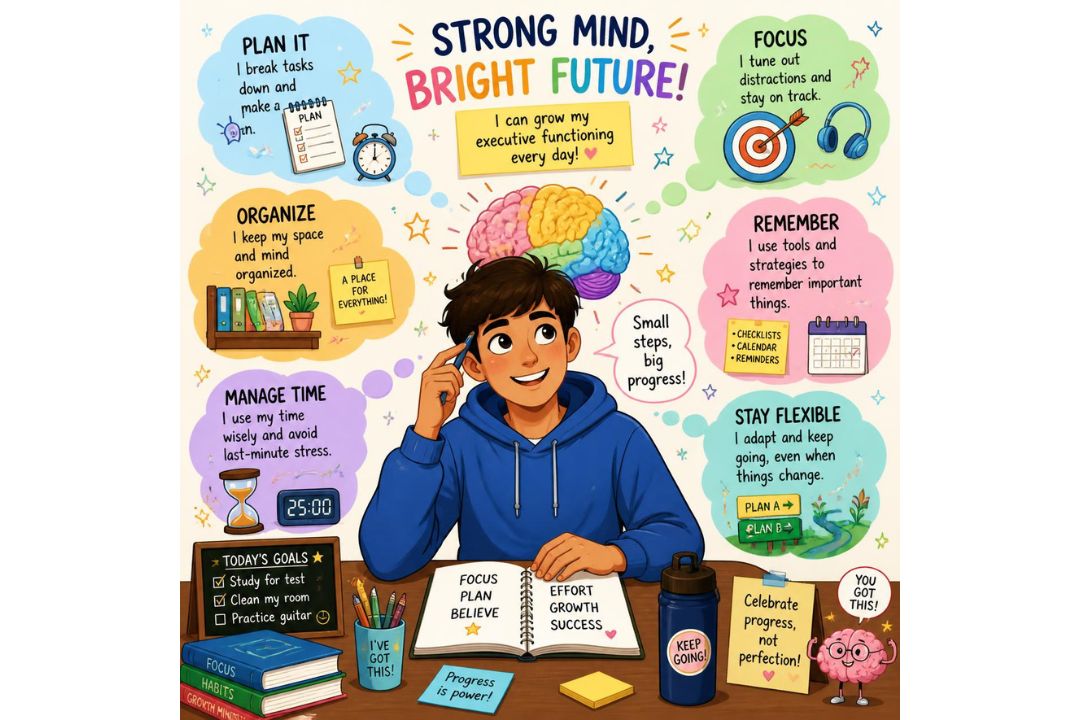
These responsibilities require far more than intelligence or motivation. They depend on a group of thinking skills known as executive functions.
At The Therapy Network (TTN), our occupational therapists often work with teenagers who understand what they need to do but find it difficult to organise themselves well enough to begin, continue or complete it.
They may say:
“I forgot.”
“I didn’t know where to start.”
“I thought I had more time.”
“I knew it was due, but I couldn’t make myself begin.”
“I had everything ready, but I left it at home.”
These experiences can be frustrating for teenagers, families and teachers. However, they are not necessarily signs of laziness, carelessness or a lack of concern.
The teenager may be experiencing genuine executive functioning barriers.
What Are Executive Functions?
Executive functions are the mental processes that help us manage our thoughts, actions, emotions and responsibilities.
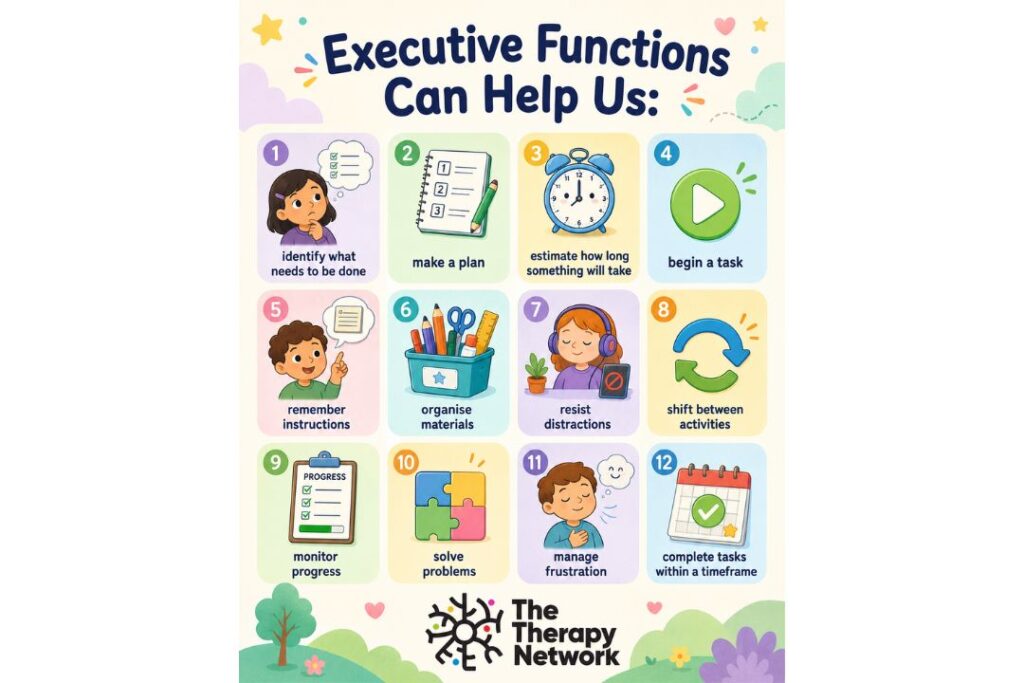
They help us:
- identify what needs to be done
- make a plan
- estimate how long something will take
- begin a task
- remember instructions
- organise materials
- resist distractions
- shift between activities
- monitor progress
- solve problems
- manage frustration
- complete tasks within a timeframe
These skills work together throughout the day.
For example, completing an assignment may require a teenager to understand the task, gather materials, choose a topic, divide the project into steps, estimate the time required, begin before the deadline, resist distractions and check the finished work.
A difficulty at any point can affect the entire process.
Executive Functioning Is Still Developing During Adolescence
Teenagers are often expected to behave like adults before they have fully developed adult-level planning and organisational skills.
Adolescence is an important period of increasing independence, but executive functions continue to mature as young people gain experience and practise managing more complex demands.
Some teenagers need more direct teaching, environmental support and repetition than others.
Executive functioning challenges may be particularly noticeable for young people with:
- ADHD
- autism
- learning differences
- developmental coordination difficulties
- language or communication differences
- anxiety
- sensory processing differences
- disrupted sleep
- high levels of stress
- mental health challenges
A diagnosis is not required for a teenager to experience difficulties with planning, time management or organisation.
Executive functioning capacity can also change from day to day. A teenager may manage well when they are rested and interested in a task but find the same skills much harder when they are tired, anxious, overwhelmed or facing several deadlines at once.
When “They Know What to Do” Is Not Enough
Adults may become frustrated because the teenager has been reminded many times.
However, knowing what to do does not always mean a young person can consistently carry it out.
A teenager might know that an assignment is due on Friday but still struggle to:
- work backwards from the deadline
- decide when to begin
- estimate how much can be completed each day
- organise the necessary materials
- stop a preferred activity
- manage anxiety about the task
- recognise that they are falling behind
- ask for help early enough
Repeated reminders such as “You need to be more organised” identify the problem without teaching the skill.
As Occupational Therapists we help make the hidden steps visible and establish systems that reduce how much the teenager must hold in their head at once.
Planning: Turning a Large Task Into Manageable Steps
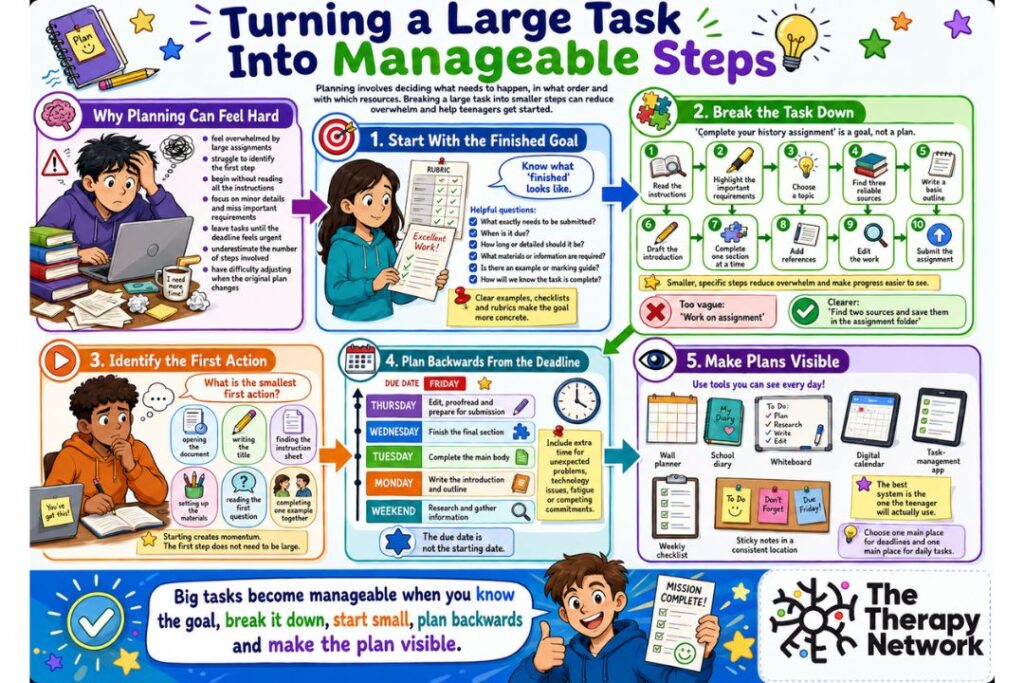
Planning involves deciding what needs to happen, in what order and with which resources.
Teenagers with planning difficulties may:
- feel overwhelmed by large assignments
- struggle to identify the first step
- begin without reading all the instructions
- focus on minor details and miss important requirements
- leave tasks until the deadline feels urgent
- underestimate the number of steps involved
- have difficulty adjusting when the original plan changes
Start With the Finished Goal
Before making a plan, the teenager needs a clear understanding of what “finished” looks like.
Helpful questions include:
- What exactly needs to be submitted?
- When is it due?
- How long or detailed should it be?
- What materials or information are required?
- Is there an example or marking guide?
- How will we know the task is complete?
Vague expectations increase executive functioning demands.
Seeing an example, checklist or assessment rubric can make the goal more concrete.
Break the Task Down
“Complete your history assignment” is a goal, not a plan.
The task may need to be divided into smaller actions, such as:
- Read the instructions.
- Highlight the important requirements.
- Choose a topic.
- Find three reliable sources.
- Write a basic outline.
- Draft the introduction.
- Complete one section at a time.
- Add references.
- Edit the work.
- Submit the assignment.
Smaller steps reduce overwhelm and make it easier to begin.
The steps should be specific enough that the teenager can recognise when each one is complete. “Work on assignment” is difficult to measure. “Find two sources and save them in the assignment folder” is clearer.
Identify the First Action
Task initiation is often a major barrier.
A teenager may sit in front of a task without beginning because the starting point feels unclear or emotionally uncomfortable.
Instead of asking, “Why haven’t you started?”, try:
“What is the smallest first action?”
It might be:
- opening the document
- writing the title
- finding the instruction sheet
- setting up the materials
- reading the first question
- completing one example together
Starting creates momentum. The first step does not need to be large.
Plan Backwards From the Deadline
Working backwards helps teenagers see that the due date is not the same as the starting date.
For a task due on Friday, the plan might be:
- Thursday: Edit, proofread and prepare for submission.
- Wednesday: Finish the final section.
- Tuesday: Complete the main body.
- Monday: Write the introduction and outline.
- Weekend: Research and gather information.
Include extra time for unexpected problems, technology issues, fatigue or competing commitments.
A plan that requires everything to go perfectly is unlikely to be sustainable.
Make Plans Visible
Plans are more effective when they are recorded somewhere the teenager regularly sees.
Possible options include:
- a wall planner
- a school diary
- a whiteboard
- a digital calendar
- a task-management app
- a weekly checklist
- sticky notes in a consistent location
Sample Wall Planner
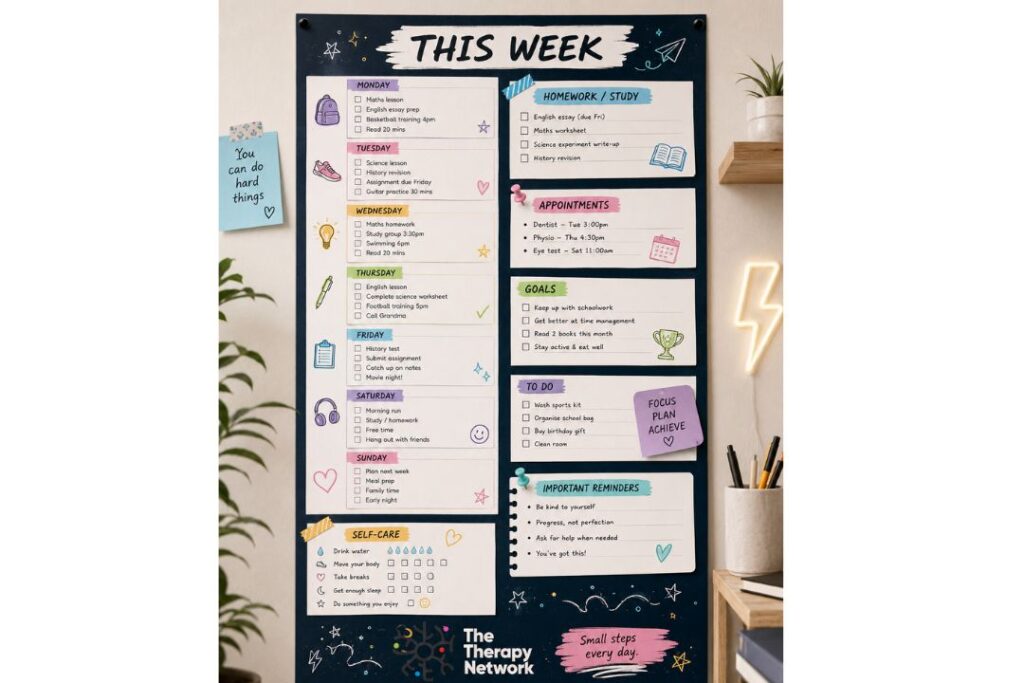
The best system is not necessarily the most advanced one. It is the one the teenager will actually use.
Using several unrelated systems can make organisation harder. Where possible, choose one main location for deadlines and one main location for daily tasks.
Time Management: Making Time Easier to See
Time management involves understanding how long tasks take, deciding when to complete them and moving between activities at appropriate times.
Many teenagers experience time blindness, meaning they have difficulty sensing the passage of time or estimating how long an activity will take.
They may:
- believe they have “plenty of time” until a deadline is very close
- spend much longer than expected on one activity
- lose track of time while gaming, scrolling or socialising
- underestimate travel or preparation time
- find it difficult to stop a preferred task
- rush through morning routines
- begin studying too late in the evening
- become distressed when plans change
Replace General Time With Specific Time
“Do your homework later” does not provide a clear starting point.
A more useful plan is:
“At 4:30 pm, complete the first two maths questions at the kitchen table.”
This identifies:
- when the task will begin
- what will be completed
- where it will happen
Specific plans reduce the need to make decisions in the moment.
Estimate and Then Check
Teenagers can practise estimating how long a task will take and comparing the estimate with the actual time.
For example:
“I think packing my school bag will take five minutes.”
After completing it, they can check whether it took five, ten or fifteen minutes.
This is not about proving the teenager wrong. It helps them develop a more accurate internal understanding of time.
Over time, they may learn that:
- showering and getting dressed takes 25 minutes
- travelling to school takes 20 minutes
- completing one page of homework takes 15 minutes
- starting a task often takes longer than expected
- transitions require additional time
Use External Time Supports
Time is invisible, so it often needs to be made visible.
Helpful tools may include:
- visual timers
- phone alarms
- calendar reminders
- countdowns
- analogue clocks
- scheduled prompts
- time-blocking on a weekly planner
One alarm may indicate that it is time to prepare to stop an activity, while another indicates that it is time to transition.
For example:
- 7:30 pm—finish the current game or video
- 7:40 pm—put away technology
- 7:45 pm—begin shower routine
This can feel more manageable than an unexpected instruction to stop immediately.
Use Time Blocks
Time blocking involves assigning a specific period to a task.
A teenager might plan:
- 4:00–4:30 pm: snack and recovery time
- 4:30–5:00 pm: maths homework
- 5:00–5:10 pm: movement break
- 5:10–5:40 pm: English assignment
- 5:40 pm onwards: preferred activity
Time blocks should include breaks and realistic transition time.
Expecting a teenager to move directly from a demanding school day into several hours of uninterrupted homework may not reflect their current capacity.
Match Demanding Tasks to Available Energy
Time management is not only about finding an empty space in the calendar. It also involves considering when the teenager is most able to think and focus.
A young person may find complex tasks easier:
- after a snack and movement break
- before becoming tired in the evening
- in a quiet environment
- on days without multiple extracurricular commitments
- when a trusted person is available to help them start
A schedule should account for energy, sensory needs and emotional regulation—not just available minutes.
Build in Buffer Time
Many teenagers plan according to how long an activity takes when everything goes smoothly.
Buffer time allows for:
- difficulty finding belongings
- slower transitions
- unexpected conversations
- transport delays
- technology problems
- emotional overwhelm
- additional preparation
Leaving ten extra minutes in the morning may be more effective than repeatedly telling a teenager to hurry.
Organisation: Creating Systems That Are Easy to Maintain
Organisation involves keeping track of information, belongings and responsibilities.
A teenager experiencing organisational challenges may:
- lose worksheets or equipment
- forget what needs to be taken to school
- have multiple unfinished notebooks
- struggle to find files on their computer
- leave assignments at home
- forget sports uniforms or chargers
- accumulate clutter in their bag, desk or bedroom
- use a new system briefly and then abandon it
The answer is rarely a more complicated storage system.
Effective organisation reduces decisions and makes it obvious where items belong.
Give Important Items a Consistent Home
Frequently used belongings should have a predictable location.
This might include:
- keys placed in a tray near the door
- the school bag kept on one hook
- chargers stored at a designated station
- sports equipment kept in one labelled container
- completed schoolwork placed in a specific folder
- devices charged overnight in the same location
The fewer places an item could be, the easier it is to locate.
Use Labels and Visual Cues
Labels reduce reliance on memory.
Teenagers may benefit from:
- labelled folders
- colour-coded subjects
- clear containers
- photographs showing how a space should be organised
- a checklist inside the wardrobe
- a packing list attached to the school bag
- calendar reminders linked to required equipment
Visual systems should be simple and age-appropriate. Teenagers are more likely to use supports they helped select and do not find embarrassing.
Create a Reset Routine
Organisation is not a one-time task. Systems need regular maintenance.
A short weekly reset might include:
- clearing old papers from the school bag
- checking the upcoming calendar
- charging devices
- organising folders
- preparing sports equipment
- identifying upcoming deadlines
- replacing missing stationery
A regular 10- or 15-minute reset is usually more manageable than waiting until the system becomes unworkable.
Prepare the Night Before
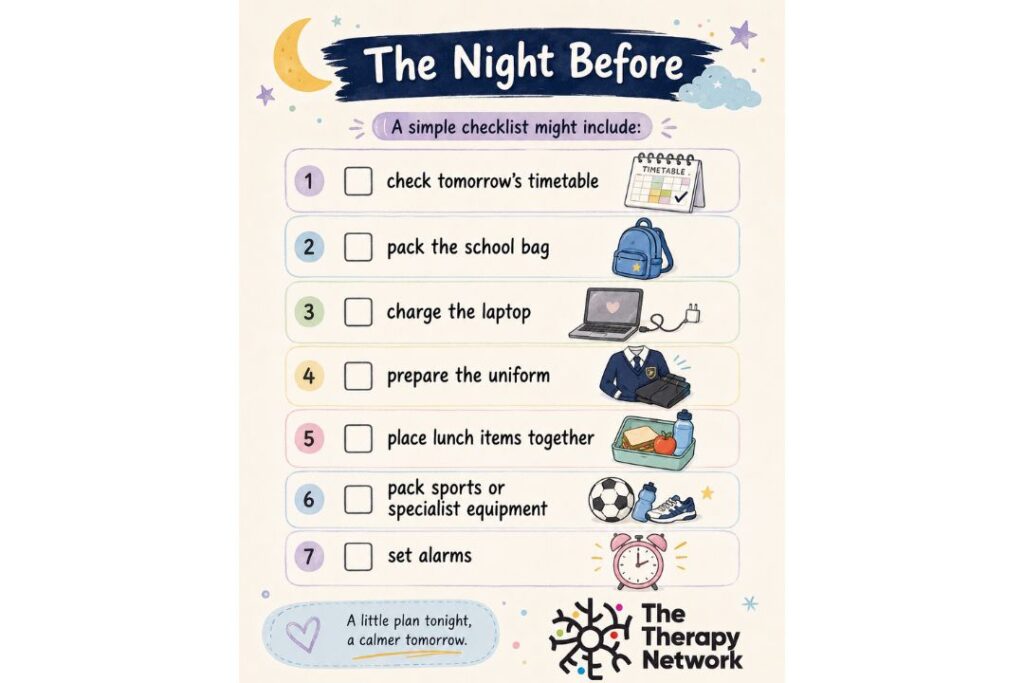
Evening preparation reduces the number of decisions required during rushed mornings.
A simple checklist might include:
- check tomorrow’s timetable
- pack the school bag
- charge the laptop
- prepare the uniform
- place lunch items together
- pack sports or specialist equipment
- set alarms
The checklist should remain in a consistent and visible location.
Sample “Night before” visual
Organise Digital Information
Digital clutter can be just as challenging as physical clutter.
Helpful strategies include:
- creating one folder for each subject
- using consistent file names
- saving work immediately in the correct location
- removing duplicate documents
- bookmarking frequently used school platforms
- setting calendar reminders for online submissions
- checking that work has actually uploaded
“English assignment final new version 4” is difficult to track.
A more consistent name might be:
English_PersuasiveEssay_Term3
Reduce the Number of Organisational Systems
A teenager may receive information through school platforms, emails, paper handouts, text messages and verbal instructions.
Where possible, important responsibilities should be transferred into one central system.
For example:
- all deadlines go into one calendar
- all daily tasks go onto one checklist
- all school documents are stored in subject folders
A system should reduce the amount the teenager needs to remember—not create another responsibility to manage.
Support Without Taking Over
Families often face a difficult balance.
Too little support may leave the teenager overwhelmed. Too much support may result in adults managing every deadline, bag and morning routine.
The goal is scaffolding: providing enough assistance for success and gradually reducing that assistance as skills develop.
This might progress from:
- An adult creates the checklist and completes it with the teenager.
- The teenager uses the checklist while the adult prompts.
- The teenager uses it independently and asks for help when needed.
- The teenager reviews whether the system still works and adjusts it.
Independence does not mean doing everything without tools or support. Adults use calendars, reminders, lists and routines every day.
The aim is for the young person to understand which tools help them and how to use those tools with increasing independence.
Collaborate Rather Than Impose
Teenagers are more likely to use strategies when they are involved in developing them.
Instead of saying:
“You need to use this planner.”
Try asking:
- “Where do you usually look for reminders?”
- “Would a written or digital system be easier?”
- “Which part of the afternoon is most difficult?”
- “What would help you remember your sports equipment?”
- “Do you want a reminder before the task or at the time it begins?”
- “How can we make this system simpler?”
A system that looks excellent to an adult may not suit the teenager’s preferences, routines or school environment.
Focus on One Area at a Time
Trying to fix planning, sleep, homework, punctuality, bedroom organisation and device use all at once can quickly become overwhelming.
Choose one meaningful priority.
For example:
- submitting assignments on time
- leaving home with the necessary equipment
- beginning homework without repeated conflict
- preparing for school the night before
Once the first system becomes familiar, another skill can be introduced.
Notice Effort and Strategy Use
Praise should focus not only on the final result but also on the process.
For example:
“You checked the calendar before making your plan.”
“You broke that task into smaller steps.”
“You noticed you were running out of time and adjusted your plan.”
“You used your checklist without being reminded.”
This helps teenagers recognise which strategies contributed to success.
How Can we as Occupational Therapist Help?
As Occupational therapists we at TTN support people to participate in meaningful everyday activities.
For teenagers, these activities may include:
- attending and participating at school
- completing homework
- preparing for assessments
- managing morning and evening routines
- travelling independently
- participating in employment
- completing household tasks
- managing personal care
- maintaining friendships and leisure activities
As an occupational therapist we do not simply teach a teenager to use a diary.
We explore why the task is difficult and consider the interaction between the young person, the activity and their environment.
Understanding the Teenager’s Executive Functioning Profile
As an OT we may gather information about:
- planning and problem-solving
- working memory
- task initiation
- time awareness
- attention and distraction
- emotional regulation
- sensory processing
- sleep and fatigue
- motor or handwriting demands
- learning environments
- existing routines
- the teenager’s goals, strengths and interests
A teenager may appear disorganised for several different reasons.
They may not remember the instruction, understand the task, sense the passage of time, tolerate the environment or know how to begin.
We know it is essential that the strategy needs to match the actual barrier.
Analysing Everyday Tasks
As OT’s we can break down specific activities such as:
- getting ready for school
- completing a long-term assignment
- studying for a test
- packing for sport
- managing a casual work schedule
- using public transport
- preparing a simple meal
By identifying where the process breaks down, the OT can recommend targeted supports.
Developing Individualised Systems
Depending on the teenager, our support may include:
- visual or digital planning tools
- task checklists
- time-management strategies
- environmental changes
- routines for beginning work
- methods for organising physical and digital materials
- sensory or movement breaks
- strategies for managing distractions
- body-doubling or supported work periods
- self-monitoring tools
- approaches for requesting help or clarification
Supporting Self-Advocacy
Teenagers benefit from understanding their own learning and organisational needs.
As an OT we may help them communicate:
- “I need the instructions written down.”
- “I need help identifying the first step.”
- “Can we divide this project into smaller deadlines?”
- “I need a quieter place to complete this work.”
- “Can I use a reminder on my phone?”
- “I need a short break before I continue.”
Self-advocacy allows the teenager to take greater ownership of their support.
Collaborating With Families and Schools
Executive function strategies are more effective when the adults around the teenager use consistent language and expectations.
As occupational therapist we value collaborating with families and educators to:
- clarify expectations
- establish realistic routines
- reduce unnecessary demands
- identify suitable school accommodations
- support assignment planning
- create consistent organisational systems
- gradually reduce adult prompting
- monitor whether the strategies are working
Progress Is More Than a Perfectly Organised Desk
Executive function progress may look like:
- beginning a task with one prompt instead of five
- checking a calendar independently
- remembering most equipment
- asking for help before the deadline
- estimating time more accurately
- using a checklist without embarrassment
- recovering when a plan changes
- submitting more work on time
- recognising when a system is not working
- developing a new strategy instead of giving up
These are meaningful steps towards independence.
Building Skills for Life Beyond School
Planning, time management and organisation affect far more than academic performance.
They support a young person to:
- manage employment
- attend appointments
- maintain relationships
- complete household tasks
- participate in community activities
- manage finances
- travel independently
- care for their health and wellbeing
- pursue personal goals
At The Therapy Network, our occupational therapists help teenagers develop practical strategies that fit their individual needs, routines and goals.
The aim is not to create a perfectly organised teenager.
It is to help young people understand how their brain works, identify tools that support them and build the confidence to manage everyday responsibilities with greater independence.
Because when we move beyond “Just try harder” and begin teaching the hidden skills behind organisation, teenagers are better able to turn their intentions into action.