Looking Beyond What We Can See
When a child is struggling emotionally, adults often notice the behaviour first.
We may see:
- refusal
- tears
- anger
- avoidance
- withdrawal
- aggression
- constant movement
- difficulty concentrating
- shutting down
- difficulty coping with change.
These behaviours are important, but they rarely tell us the whole story.
As Occupational Therapists, we are often interested in asking a different question:
What might this behaviour be communicating?
A child who refuses to enter the classroom may be worried about what is going to happen inside.
A child who becomes angry during homework may be overwhelmed by the planning, attention or writing demands of the task.
A child who appears unable to sit still may be seeking movement in order to stay regulated.
A child who melts down after school may have spent the entire day managing noise, social expectations, transitions and sensory demands.
When we look beyond the behaviour, we can begin to understand the child’s experience more clearly.
Emotional Wellbeing Happens in Everyday Life
Mental health is not separate from daily routines.
For children and young people, emotional wellbeing is influenced by what happens during the ordinary occupations that fill their day.
That includes:
- getting ready for school
- eating and mealtimes
- learning
- completing homework
- playing
- socialising
- managing transitions
- participating in family routines
- using technology
- sleeping
- engaging in hobbies
- spending time in the community.
If these activities regularly feel confusing, exhausting, unpredictable or overwhelming, they can place additional pressure on a child’s emotional wellbeing.
Occupational Therapy looks at how we can make everyday participation feel more manageable.
Behaviour Can Be Communication
One of the most important things we can do for children is avoid assuming that difficult behaviour is simply a choice.
Sometimes behaviour may reflect:
Sensory overload – the environment is too loud, bright, busy or unpredictable.
Fatigue – the child has used significant energy managing expectations throughout the day.
Executive functioning demands – they are struggling to start, plan, organise or complete a task.
Communication difficulties – they know something is wrong but cannot easily explain it.
Uncertainty – they do not know what is going to happen next.
Fear of failure – the task feels too difficult or they have experienced previous negative outcomes.
Interoception difficulties – they may not recognise internal signals such as hunger, tiredness, tension or increasing anxiety until those feelings become overwhelming.
Understanding the reason behind a behaviour allows us to respond with support rather than simply correction.
Regulation Before Expectation
Children are better able to learn, communicate and problem-solve when they feel regulated and safe.
When a child is overwhelmed, continuing to increase demands may make participation harder.
An OT might help families and educators consider strategies such as:
- movement opportunities
- sensory breaks
- quiet spaces
- visual schedules
- predictable routines
- reducing unnecessary demands
- allowing additional processing time
- breaking tasks into smaller steps
- offering meaningful choices
- preparing for changes in advance.
The goal is not to remove every challenge from a child’s life.It is to provide enough support that they can engage with challenges without becoming continually overwhelmed.
The Importance of Sensory Processing
Our sensory systems are constantly receiving information from the world around us.
Noise, movement, touch, smells, lighting, clothing, crowds and body sensations can all influence how regulated we feel.
For some children, sensory information may be experienced more intensely or differently.
Imagine trying to concentrate while the classroom lights feel painfully bright, the scrape of chairs is impossible to ignore and the person beside you keeps brushing against your arm.
What looks like distractibility, avoidance or irritability may actually be a nervous system working very hard to cope.
OTs can help identify sensory patterns and explore practical ways to make environments and activities more manageable.
Routines Can Create Emotional Safety
Predictability can be reassuring.
Knowing what is happening next reduces the amount of mental energy a child needs to spend anticipating and organising their day.
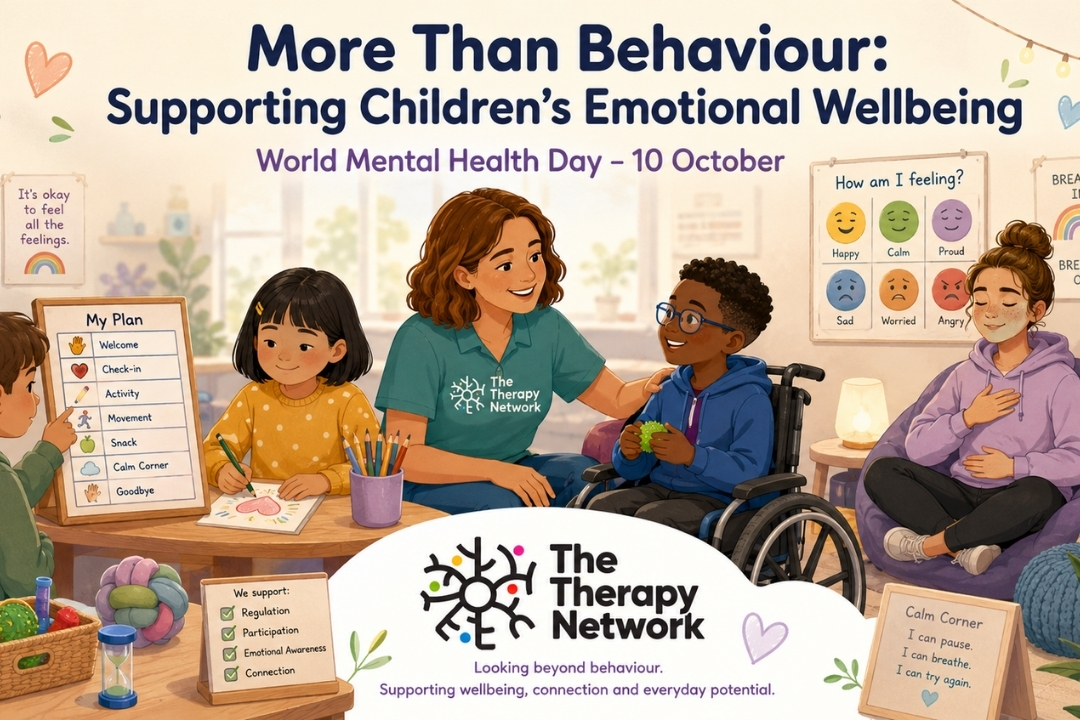
Visual schedules, checklists and consistent routines can be particularly helpful for children who find transitions, working memory or unexpected changes difficult.
A predictable routine does not mean life has to be rigid.
Instead, routines can provide a secure framework from which children gradually learn to manage flexibility.
We might use:
- morning checklists
- visual timetables
- “first, then” supports
- countdowns before transitions
- calendars for upcoming events
- plans for what to do when something changes.
These supports can reduce uncertainty and give children a greater sense of control.
Play Is Good for Emotional Wellbeing
Play is not simply something children do after the “important” activities are finished.
Play is an important occupation in its own right.
Through play, children can:
- connect with others
- experiment with ideas
- express emotions
- practise problem-solving
- experience success
- develop confidence
- move their bodies
- use imagination
- experience joy.
For some children, unstructured play can also be difficult because of social, sensory or executive functioning demands.
OTs can help identify ways to support participation without removing the child’s autonomy or turning every play experience into therapy.Sometimes the most therapeutic thing about play is simply having the opportunity to enjoy it.
Friendships and Belonging Matter
Mental wellbeing is also closely connected to belonging.
Children need opportunities to feel accepted, included and valued.
Social participation can be particularly demanding for children who find it difficult to interpret social cues, manage group dynamics, communicate their ideas or stay regulated in busy settings.
Support may involve helping a child develop strategies for:
- entering play
- communicating preferences
- negotiating disagreements
- recognising when they need a break
- finding peers with shared interests
- navigating different social environments.
Importantly, the goal should not be to make every child socialise in the same way.
A child who prefers one close friend or quieter social activities does not necessarily need to become someone who enjoys large groups.
Participation should reflect the individual child.
Supporting Emotional Awareness
Before children can regulate emotions, they often need help recognising what is happening inside their bodies.
This is where interoception can be important.
A child may notice:
- a fast heartbeat
- tight muscles
- butterflies in their stomach
- feeling hot
- clenched hands
- needing to move
- feeling heavy or tired.
Helping children notice these signals can support them to recognise when they are becoming worried, frustrated, tired or overwhelmed.
Over time, this can help them learn strategies such as asking for a break, finding a quieter environment, moving their body or seeking support before their emotions become too intense.
Building Independence Without Removing Support
Supporting emotional wellbeing does not mean expecting children to regulate independently before they are ready.
Regulation develops through relationships.
Children often need co-regulation first — a calm, supportive adult helping them make sense of their feelings and providing the structure they need.
As skills develop, the amount and type of support may gradually change.
Independence might eventually look like a child:
- recognising that they need a break
- choosing a regulation strategy
- communicating that something feels overwhelming
- preparing for a difficult transition
- using a visual support independently
- advocating for an environmental adjustment.
Being able to ask for help is also a form of independence.
Supporting the Whole Family
A child’s emotional wellbeing does not exist in isolation from family life.
When daily routines are consistently difficult, the impact can be felt by everyone.
Mornings may become stressful.
Homework may become a source of conflict.
Bedtime may take hours.
Parents may feel they are constantly anticipating the next challenge.
OTs can work collaboratively with families to identify where everyday routines are becoming difficult and look for realistic changes.
The goal is not to add another long list of strategies for families to manage.
Sometimes the most helpful intervention is making something simpler.
Mental Health and Participation Are Connected
When children feel emotionally safe and supported, they are more able to engage in the activities that are important to them.
And meaningful participation can also support mental health.
Being able to play, learn, connect with friends, participate in family routines, pursue interests and experience success can all contribute to a child’s sense of competence and belonging.
This is one of the reasons Occupational Therapy can play an important role in supporting emotional wellbeing.
We look at the child, the activity and the environment together.
Rather than asking only:
“How do we stop this behaviour?”
We can ask:
“What is making this difficult?”
“What does this child need?”
“What can we change?”
From the OTs at TTN
This World Mental Health Day, the Occupational Therapists at The Therapy Network encourage families, educators and communities to look beyond what is immediately visible.
Behaviour can be a signal.
Avoidance can be communication.
Movement can be regulation.
A child who appears unwilling may actually be overwhelmed.
By understanding the sensory, emotional, cognitive and environmental demands behind everyday activities, we can create supports that help children feel safer, more capable and more connected.
Because supporting children’s mental health is not only about what happens when things become difficult.
It is also about creating everyday routines, relationships and environments where children have opportunities to participate, belong, succeed and be understood.