
“Are you OK?”
It is a simple question—but for a child who is worried, overwhelmed, confused, or unsure how to explain what they are feeling, the answer may not be simple at all.
On Thursday 10 September 2026, Australians will recognise R U OK? Day, the national day of action that reminds us to stay connected and begin meaningful conversations with people who may be struggling. The broader message for 2026 is to ask R U OK? any day, recognising that life’s challenges do not occur on only one date each year.
At The Therapy Network (TTN), this message connects strongly with the work we do every day.
Paediatric occupational therapy is not only about handwriting, motor skills, or independence. It is also about helping children understand their bodies, recognise their emotions, communicate their needs, participate in relationships, and feel safe enough to ask for support.
R U OK?Day gives families, therapists, and communities an opportunity to consider an important question:
How can we help children feel comfortable telling us when they are not OK?
Why Checking In With Children Matters
Children experience worries, disappointments, friendship difficulties, sensory overload, academic pressure, family changes, and uncertainty just as adults do.
However, they may not yet have the emotional awareness or communication skills needed to explain what is happening.
Instead of saying:
- “I feel anxious.”
- “The classroom is overwhelming.”
- “I am worried my friends do not like me.”
- “I do not understand what is expected.”
- “I need a break.”
A child may:
- Become angry
- Withdraw
- Refuse an activity
- Cry over something that appears small
- Complain of feeling tired or unwell
- Become unusually quiet
- Seek constant reassurance
- Have difficulty sleeping
- Avoid school or activities
- Become more physically active or impulsive
- Say, “I don’t know”
Behaviour is often one of the ways children communicate that something does not feel right.
A meaningful check-in helps adults look beyond the behaviour and become curious about what the child may be experiencing.
Asking “Are You OK?” Is Only the Beginning
The R U OK? approach encourages four conversation steps;
- Ask
- Listen
- Encourage action
- Check in
These steps remind us that asking the initial question is important, but listening and continuing to offer support matter too.
With children, the conversation may need to be adapted to their age, communication style, developmental stage, and emotional state.
Some children will respond to a direct question.
Others may communicate more easily:
- While drawing
- During play
- In the car
- While walking
- At bedtime
- Through written notes
- Using pictures or emotion cards
- While completing an activity alongside an adult
The most effective check-in is not always a formal face-to-face conversation.
Sometimes children talk more openly when they do not feel watched, pressured, or expected to provide an immediate answer.
Why “Are You OK?” Can Be a Difficult Question
For some children, the question may feel too broad.
To answer it, a child must be able to:
- Notice what is happening inside their body
- Identify an emotion
- Understand why they feel that way
- Decide whether it is safe to share
- Organise their thoughts
- Find the right words
- Communicate while possibly feeling overwhelmed
That is a significant amount of emotional and cognitive work.
A child may genuinely not know whether they are OK.
They may also believe that saying “yes” is the expected response.
This is why adults often need to ask more specific, gentle questions.
Try Smaller, More Concrete Questions
Instead of only asking, “Are you OK?”, adults might say;
- “You seem a little quieter today. How are things going?”
- “What was the easiest part of your day?”
- “What was the hardest part?”
- “Did anything make you feel worried or uncomfortable?”
- “Did your body feel calm, busy, or tired today?”
- “Is there something you wish had gone differently?”
- “Would you like me to listen, help, or just sit with you?”
- “Do you want to tell me now, later, or in another way?”
Specific questions reduce the amount of information the child must process and can make it easier to begin.
Notice Before You Ask
Children may feel more understood when adults explain what they have noticed.
For example:
- “I noticed you have been very quiet since school.”
- “You usually enjoy soccer, but today you did not want to join.”
- “Your shoulders look tense and you are squeezing your hands.”
- “You have asked the same question a few times. I wonder whether you are feeling worried.”
- “You became upset when the plan changed. That seemed really hard.”
This communicates:
“I see you. I am paying attention. You do not have to manage this alone.”
The goal is not to tell the child what they are feeling, but to offer an observation and invite them to share.
When Children Say, “I’m Fine”
A child saying “I’m fine” does not always mean the conversation has failed.
They may:
- Need more time
- Feel unsure about what to say
- Be worried about upsetting an adult
- Fear getting into trouble
- Not have the words yet
- Prefer to talk in another setting
- Not be ready to discuss the issue
Adults can keep the door open by responding calmly:
- “That’s okay. I’m here if you want to talk later.”
- “You don’t have to explain everything right now.”
- “You can tell me, write it down, or show me another way.”
- “I’ll check in again later.”
Avoid repeatedly questioning the child in the same moment. Too much pressure may make them withdraw further.
Checking in again shows that the first question was genuine rather than a one-off gesture.
Listening Without Immediately Fixing
When a child shares something difficult, adults often want to solve the problem immediately.
We may offer advice, reassurance, explanations, or solutions before the child has finished speaking.
However, children often need to feel heard before they are ready to consider what happens next.
Helpful listening may involve:
- Pausing
- Remaining calm
- Allowing silence
- Avoiding interruption
- Reflecting what the child has said
- Acknowledging the feeling
- Asking what they need
- Thanking them for telling you
You might say:
- “That sounds like it was really difficult.”
- “I can understand why you felt left out.”
- “Thank you for telling me.”
- “You are not in trouble.”
- “I’m glad you came to me.”
- “Would you like help thinking about what to do next?”
Listening does not mean agreeing with every interpretation or behaviour. It means showing the child that their experience matters.
Connection Before Problem-Solving
Children cannot always discuss a problem while they are highly distressed.
When the nervous system is overwhelmed, thinking, language, planning, and flexible problem-solving can become much harder.
Before asking lots of questions, the child may need support to feel calmer and safer.
This may involve:
- Sitting with a trusted adult
- Moving to a quieter space
- Reducing language
- Having a drink or snack
- Taking slow breaths together
- Walking or moving
- Using a familiar sensory strategy
- Holding a comforting object
- Having time without additional demands
Once the child is more regulated, the adult can return to the conversation.
This is known as co-regulation—an adult offering calm, predictable support that helps the child gradually manage their emotional state.
Some Children Communicate Differently
Not every child communicates through spoken conversation.
Children may use:
- Gestures
- Facial expressions
- Behaviour
- Drawing
- Writing
- Visual choices
- Communication devices
- Sign
- Play
- Movement
- Changes in routine or participation
For autistic children, children with ADHD, children with developmental differences, or children who use augmentative and alternative communication, a traditional question-and-answer conversation may not be the most accessible way to check in.
Adults can offer alternatives such as:
- Emotion cards
- A visual feelings scale
- Colour zones
- Body maps
- Drawing
- A choice between two or three feelings
- A written message
- Selecting a symbol on a device
- Showing whether a problem feels small, medium, or large
Communication should not be judged by how closely it resembles spoken adult conversation.
Supporting Emotional Awareness
What matters is that the child has a safe and reliable way to express their experience.
Before children can tell us how they feel, they need opportunities to develop emotional awareness.
Families can support this by naming emotions during everyday moments:
- “You look excited about going to the park.”
- “Waiting is feeling frustrating.”
- “Your body seems tired after that busy day.”
- “The loud noise startled you.”
- “You seem disappointed that the game ended.”
Books, television programs, play, and real-life situations can also be used to explore:
- What a character may be feeling
- What clues show that emotion
- What may have caused it
- What the character could do
- Who they could ask for help
The aim is not to label every feeling for the child. It is to build a language they can draw upon when they need it.
Recognising Feelings in the Body
Emotions are experienced physically as well as mentally.
Children may notice:
- A fast heartbeat
- Tight muscles
- A sore stomach
- Sweaty hands
- Shaky legs
- A hot face
- A heavy body
- Restlessness
- A lump in the throat
- Difficulty sitting still
Helping children connect body signals with emotions can make it easier for them to recognise when they need support.
An adult might ask:
- “What is your body telling you?”
- “Does your body feel fast or slow?”
- “Where do you notice the worry?”
- “Do you need movement, quiet, connection, or space?”
This body-awareness skill is sometimes called interoception.
Creating a Culture of Everyday Check-Ins
The official R U OK? message encourages Australians to ask the question on any day, rather than waiting for the annual event.
For families, this might look like:
- A relaxed conversation during dinner
- A bedtime check-in
- Asking about the high and low point of the day
- Taking a walk together
- Leaving a note for an older child
- Having a feelings chart available
- Creating regular one-to-one time
- Checking in after a difficult event
- Following up on something the child previously shared
The goal is not to question children constantly.
It is to build a relationship in which conversations about feelings feel normal, safe, and welcome.
Avoiding the “Perfect Conversation”
Adults may worry about using the wrong words.
But a meaningful conversation does not require a perfect script.
Children are more likely to remember whether an adult:
- Stayed calm
- Believed them
- Took them seriously
- Avoided judgement
- Continued to care
- Helped them access support
Simple language is often enough:
- “I’m here.”
- “You can tell me.”
- “We will work it out together.”
- “You are not alone.”
- “Let’s find someone who can help.”
What Might Make It Hard for a Child to Open Up?
Children may hesitate to share because they:
- Do not want to worry their family
- Fear consequences
- Feel embarrassed
- Think the problem is their fault
- Believe adults will not understand
- Have previously felt dismissed
- Are worried the adult will become angry
- Do not know how to begin
- Expect the conversation to become too intense
- Have difficulty identifying or expressing feelings
Adults can make conversations safer by remaining predictable and responding without blame or panic.
When a Child Shares Something Important
If a child discloses that they feel unsafe, are being harmed, are being bullied, or are experiencing significant emotional distress, the adult should take the information seriously.
Helpful first responses include:
- “Thank you for telling me.”
- “This is not your fault.”
- “You did the right thing by speaking up.”
- “I need to get some help to keep you safe.”
- “I will explain what happens next.”
Adults should follow appropriate child-safety, school, organisational, and professional procedures and seek qualified support where needed.
A wellbeing conversation is valuable, but it is not a replacement for assessment or professional mental health care when a child requires additional help.
Signs a child May Need More Support
Consider seeking professional advice when changes are persistent, significant, or affecting everyday participation.
Signs may include:
- Ongoing withdrawal
- Major changes in sleep or appetite
- Regular school refusal
- Loss of interest in preferred activities
- Frequent emotional distress
- Significant changes in behaviour
- Increased aggression or shutdown
- Persistent physical complaints without a clear cause
- Difficulty participating in family, school, or social life
- Statements suggesting hopelessness, worthlessness, or feeling unsafe
Families can begin by speaking with a general practitioner, school wellbeing professional, psychologist, paediatrician, or another appropriately qualified practitioner.
How Occupational Therapy Can Support Emotional Wellbeing
Occupational therapists do not replace psychologists, counsellors, or medical practitioners.
However, occupational therapy can support many of the functional skills that help children participate in everyday life and communicate when something is difficult.
An occupational therapist may help a child develop:
- Emotional awareness
- Body-signal recognition
- Sensory regulation
- Communication strategies
- Coping routines
- Flexible thinking
- Independence
- Self-advocacy
- Confidence asking for help
- Participation in school, play, and family life
Occupational therapists may also work with families to create environments that feel more predictable, accessible, and supportive.
Practical R U OK? Day Activities for Families
Create a Family Check-In Jar
Write simple questions on pieces of paper, such as:
- What made you smile today?
- What felt difficult?
- Who helped you today?
- Is there anything you need help with?
- What are you looking forward to?
Choose one during dinner or family time.
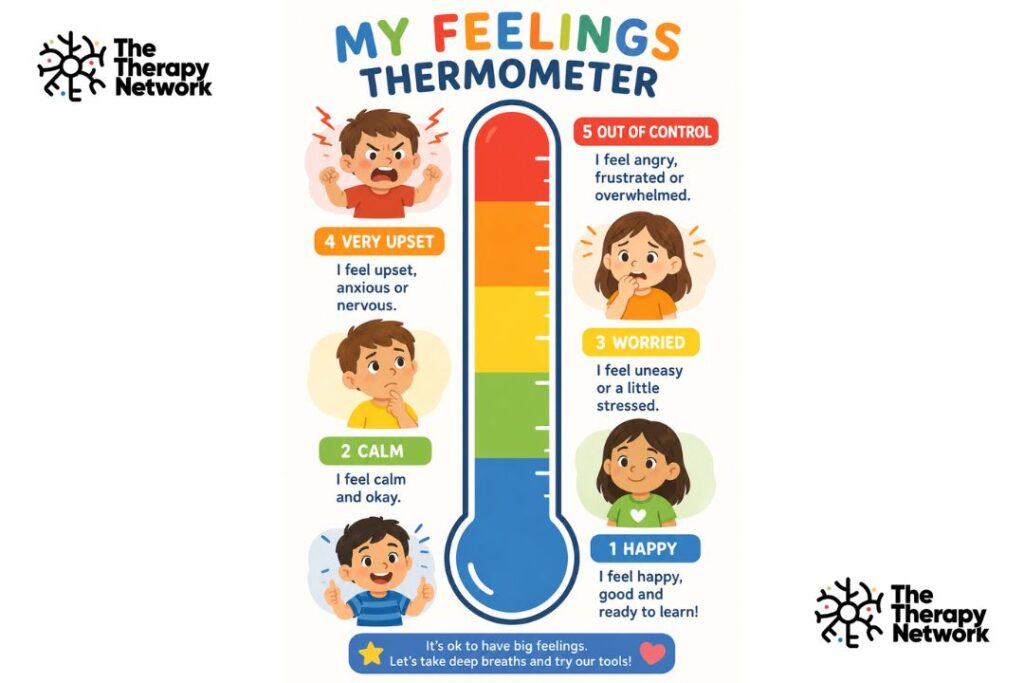
Use a Feelings Thermometer
Create a scale from calm to overwhelmed and encourage family members to show where they are throughout the day.
Take a Connection Walk
Walk together without screens or other distractions. Some children find it easier to talk while moving beside someone.
Make a List of Safe Adults
Help the child identify adults they can approach at home, school, and in the community.
Practise Helpful Responses
Role-play what a child might say if a friend tells them they are struggling:
- “I’m glad you told me.”
- “Do you want to find a teacher?”
- “Let’s talk to an adult together.”
- “I’ll check on you again tomorrow.”
Create Different Ways to Ask for Help
A child might:
- Say a phrase
- Hand over a card
- Send a message
- Point to a visual
- Use a signal
- Ask for private time with an adult
Children are more likely to seek help when they know exactly how to do it.
Make R U OK? an Everyday Question
R U OK? Day provides an important opportunity to pause and connect.
But children need more than one wellbeing conversation each September.
They need relationships in which adults:
- Notice changes
- Make time to listen
- Respect different communication styles
- Remain available
- Follow up
- Seek additional help when needed
The most powerful message we can offer a child is not simply:
“Are you OK?”
It is:
“However you are feeling, you do not have to manage it alone.”
How TTN Can Help
At The Therapy Network (TTN), our paediatric occupational therapists support children to understand their bodies, recognise emotions, communicate their needs, build regulation skills, and participate more confidently in everyday life.
We work collaboratively with families, educators, and other professionals to develop practical strategies that reflect each child’s strengths, developmental needs, and communication style.
This R U OK? Day—and every day—we encourage families to create small, regular moments of connection.
Because asking the question matters.
Listening matters.
And helping children feel seen, heard, and supported can make a meaningful difference.